
The most profound facial transformations often happen in the quiet moments between appointments, rather than in a single afternoon under a surgeon’s blade. It’s natural to feel a sense of hesitation when you notice your reflection looking tired or less defined; you want to reclaim your vibrancy without losing the character that makes your face your own. Many people find themselves caught in a cycle of anxiety, weighing the fear of looking overdone against the desire for a visible lift. Understanding the choice between Sculptra vs facelift requires a shift in perspective from immediate correction to intentional restoration.
We believe that your aesthetic journey should feel like a supportive partnership rather than a high-pressure procedure. This guide will help you navigate the choice between gradual biostimulation and surgical intervention to find the most harmonious path for your unique aging journey. We will examine the clinical differences between filling volume and lifting tissue, providing clarity on recovery expectations and the long term investment required for each approach. By the end, you’ll have a clear vision of how to achieve a refreshed, well-rested appearance that honors your natural foundation and preserves your authentic self.
Key Takeaways
- Distinguish between volume loss and structural laxity to determine whether your features require biological rebuilding or surgical repositioning.
- Evaluate the practical differences of Sculptra vs facelift, comparing a serene 30-minute office visit with the recovery and anesthesia considerations of traditional surgery.
- Discover the “collagen bank” concept, where PLLA micro-particles create a scaffold that naturally restores your skin’s thickness and youthful resilience.
- Assess your candidacy using simple tools like the “pinch test” to find the ideal balance between non-invasive biostimulation and structural intervention.
- Learn how an intentional, boutique approach to care preserves your authentic character while achieving a subtle, well-rested appearance.
Understanding Facial Restoration: Rebuilding vs. Repositioning
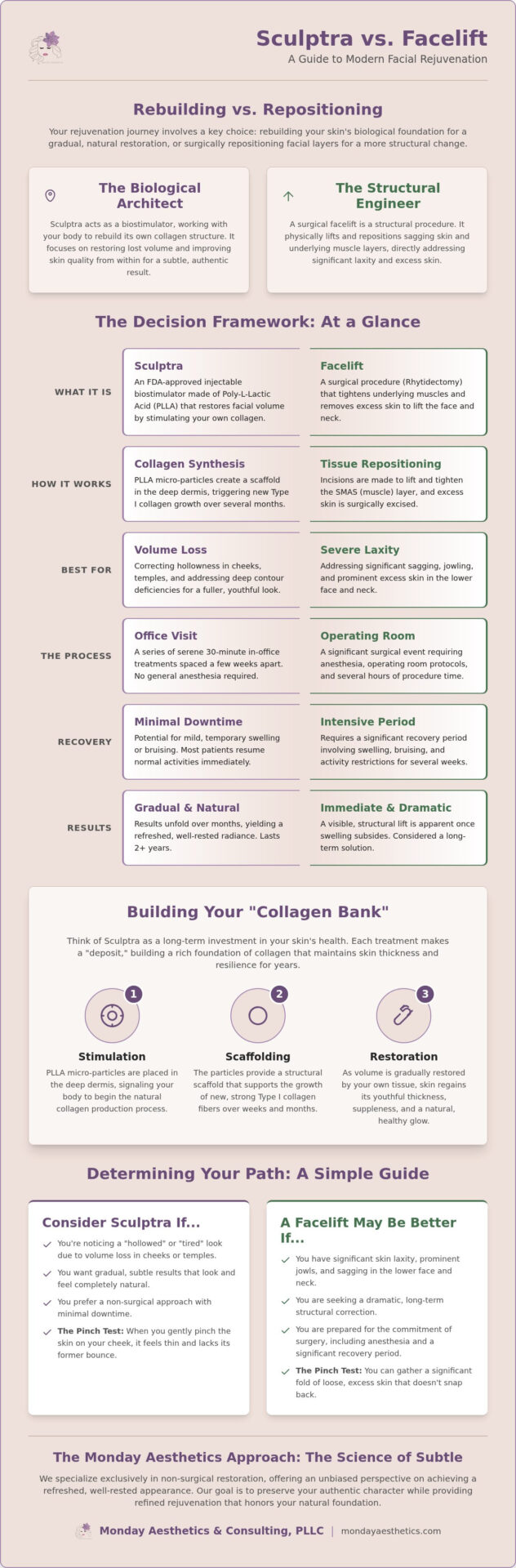
True rejuvenation begins with a clear understanding of how your face changes over time. For many, the first signs of aging appear as a subtle loss of volume, creating a hollowed or tired look that rest alone cannot fix. Others may notice a more pronounced shift where the skin and underlying tissues begin to yield to gravity. When weighing the path of Sculptra vs facelift, you’re essentially deciding between rebuilding your skin’s biological foundation and structurally repositioning its layers.
We view this choice through a distinct philosophical lens. Sculptra serves as a biological architect, focusing on the quality and volume of the skin’s foundation to restore what has been lost. A surgeon, however, acts as a structural engineer who physically repositions the facial landscape. Today’s “less-is-more” movement favors this architectural approach, as it prioritizes a gradual, undetectable restoration over a sudden, dramatic change. At Monday Aesthetics & Consulting, PLLC, we’re dedicated to the Science of Subtle, ensuring that any enhancement feels like a natural extension of your unique character rather than a departure from it.
What is Sculptra Aesthetic?
Sculptra is a sophisticated biostimulator composed of Poly-L-Lactic Acid (PLLA), a biocompatible material that has been used safely in medical implants for decades. Unlike traditional fillers that provide an immediate, gel-based volume, Sculptra works by triggering your body’s own collagen synthesis pathway. It’s an investment in your skin’s future thickness and resilience. After your treatment, the PLLA micro-particles create a scaffold that encourages your skin to produce new Type I collagen. This process takes time, typically unfolding over several months. This patience is rewarded with “The Glow,” a refined, well-rested radiance that appears so naturally that friends may simply think you’ve returned from a long, peaceful retreat.
The Scope of a Traditional Facelift
A surgical intervention, or Rhytidectomy (facelift), is a different undertaking entirely. This procedure focuses on the deeper structural layers, specifically the SMAS (muscle layer), to lift and tighten the lower face and neck. Surgery is the definitive answer for addressing significant skin excess or severe laxity that biostimulators cannot “shrink” or resolve. It offers a sense of permanence, but it also requires a significant commitment to anesthesia, operating room protocols, and a more intensive recovery period. While the debate of Sculptra vs facelift often centers on the final look, the underlying difference lies in the commitment to the process. It’s important to clarify that Monday Aesthetics & Consulting, PLLC specializes exclusively in non-surgical restoration; we don’t perform surgical plastic surgery at our Burlington practice, allowing us to provide an unbiased perspective on non-invasive alternatives.
The Science of Sculptra: A Foundation for Natural Lift
When evaluating Sculptra vs facelift, it’s helpful to view the former as a way to restore the skin’s biological structure from within. Sculptra introduces micro-particles of Poly-L-Lactic Acid (PLLA) into the deep dermis, where they act as a quiet, structural scaffold. While a traditional rhytidectomy addresses sagging by physically excising and pulling skin, Sculptra prompts your body to revitalize its own collagen production. By triggering the synthesis of Type I collagen, this treatment restores the density that time and environmental factors have slowly diminished over the years.
Think of this biological process as a “Collagen Bank.” Each treatment session serves as a meaningful deposit into your skin’s future thickness and resilience. Because the resulting volume is built from your own tissue, the transformation remains remarkably natural and undetectable to the untrained eye. There’s no risk of looking “filled” or artificial; instead, your skin simply regains the supple quality and light-reflective glow of its younger years. The FDA approval for Sculptra highlights its effectiveness in correcting deep contour deficiencies, reinforcing its role as a cornerstone of modern regenerative aesthetics.
Lifting Without the Scalpel
Restoring volume in the temples and mid-face can create a subtle “liquid lift” that softens the appearance of the lower face. When we strengthen the skin’s structural integrity, the jawline often appears more defined and the cheeks appear more youthful without the need for invasive measures. For those seeking immediate refinement while their natural collagen builds, we often suggest pairing treatment with Cheek Filler in Burlington, WA. This combination offers several benefits:
- Instant structural support from dermal fillers
- Long-term skin thickening from Sculptra
- A more balanced, multi-dimensional facial contour
Longevity and Maintenance
Unlike hyaluronic acid fillers that may require frequent touch-ups every few months, Sculptra is designed for endurance and stability. While the initial series typically involves a few sessions spaced apart, the results can last up to two years or more as your body maintains its new collagen framework. The enduring nature of these results is a key factor when comparing Sculptra vs facelift, as one provides biological longevity while the other offers surgical permanence. Maintaining this foundation is a journey of consistency and care. Many of our patients utilize Aesthetic Membership Programs in Burlington to ensure their skin receives regular, professional attention. If you’re curious about how this biostimulator fits into your long-term wellness plan, we invite you to explore our approach to graceful aging.
Sculptra vs. Facelift: The Decision Framework
Choosing between Sculptra vs facelift isn’t merely a clinical decision; it’s a lifestyle choice that dictates how you’ll spend your time and energy in the coming months. While both paths aim for a refreshed appearance, the journey to get there varies significantly in intensity. A Sculptra session is a refined, 30-minute office visit that fits seamlessly into a busy afternoon. In contrast, a surgical facelift is a multi-hour commitment in an operating room, involving complex structural changes that require a much higher level of physical and emotional preparation.
This difference extends to the anesthesia required. For Sculptra, we use simple topical numbing or a local anesthetic to ensure your comfort. Surgery typically requires general anesthesia or deep sedation, which carries inherent risks and a longer “foggy” recovery period. Financially, it’s helpful to look at the total cost of ownership over a decade. A facelift involves a significant upfront investment in surgeon’s fees, facility costs, and anesthesia. Sculptra allows for smaller, periodic investments into your “collagen bank,” making it a manageable path for those who prefer a steady, maintenance-focused approach to their facial health.
Recovery and Lifestyle Integration
For our active Skagit Valley residents, the “no-downtime” reality of biostimulators is often the deciding factor. You can return to your social life or work immediately after a Sculptra appointment, with only minor, temporary swelling. The surgical healing phase is much more demanding, often requiring two to four weeks of “social downtime.” During this period, patients must manage bruising, significant swelling, and surgical bandages. Physical restrictions are also strict; you’ll need to pause high-impact exercise, avoid travel, and decline social commitments while your body heals from the structural trauma of surgery.
Safety and Risk Profiles
The safety profile of a minimally invasive biostimulator is exceptionally high when administered in a clinical setting. Because we aren’t cutting the skin or repositioning muscles, the risks of scarring or nerve damage are virtually non-existent. Surgical procedures carry the weight of potential complications, including visible scars or permanent changes to facial expression. At Monday Aesthetics, we provide a grounded middle ground. Led by a board-certified Nurse Practitioner, our practice focuses on the Science of Subtle, prioritizing your safety and the preservation of your authentic character without the risks associated with the operating room. We don’t perform surgical plastic surgery, which allows us to focus entirely on perfecting these sophisticated, non-invasive techniques for our community.
Determining Your Path: Are You a Candidate for Sculptra?
Age is a numerical value that rarely tells the full story of your skin’s vitality. When deciding on Sculptra vs facelift, we prioritize the health of your tissue over the year on your birth certificate. A simple way to assess your own candidacy is through the “pinch test.” Gently pinch the skin on your mid-face or along the jawline and release it. If your skin retains a degree of resilience and snaps back into place, you’re likely in the “sweet spot” for biostimulation. This ideal range includes mild to moderate hollowing or early signs of laxity where rebuilding the foundation can still provide a visible, natural lift.
A personalized consultation at our Burlington practice allows us to look beyond the surface. We evaluate your bone structure, fat pad distribution, and skin quality to ensure that a non-surgical path will meet your expectations. This grounded approach ensures you aren’t just chasing a trend, but investing in a solution that respects your facial anatomy when comparing Sculptra vs facelift outcomes. By focusing on your unique structural needs, we can create a plan that feels intentional and restorative.
Targeting the Lower Face and Jawline
Sculptra is particularly adept at softening the appearance of jowls without the “pulled” or wind-swept look that can sometimes follow aggressive surgery. It strengthens the skin’s architecture, creating a smoother transition from the cheek to the chin. To achieve a truly refreshed gaze, we often recommend enhancing these results with Under Eye Filler in Burlington, which addresses the delicate hollows that make us look perpetually tired. For those concerned with the upper face, the precision of PDO Thread Brow Lifts can elevate the natural gaze, providing a comprehensive rejuvenation that remains entirely non-invasive.
When Surgery is the Logical Choice
There are moments when the most compassionate advice we can give is to acknowledge the limits of non-surgical tools. If you’re experiencing significant skin redundancy, deep structural sagging, or advanced facial ptosis, a biostimulator may not provide the elevation you desire. In these cases, the physical repositioning of a surgical facelift becomes the most logical and effective choice. Our commitment to you is one of total transparency; because we don’t perform surgical plastic surgery, we can provide an unbiased assessment of whether our treatments will truly serve your goals. If you’re ready to discover which path aligns with your journey, we invite you to schedule a consultation at Monday Aesthetics.
The Monday Aesthetics Approach to Refined Rejuvenation
At Monday Aesthetics, we believe that the environment where care is delivered is just as vital as the clinical outcome itself. Our philosophy is rooted in serenity, intentionality, and a commitment to subtle elegance. We’ve created a boutique space in Burlington that feels more like a high-end wellness retreat than a typical medical office. For our neighbors in the Skagit Valley, this local care eliminates the stress of commuting to Seattle for maintenance. We understand that the choice between Sculptra vs facelift is deeply personal. Having a dedicated, local partner ensures that your aesthetic journey remains a steady, peaceful progression rather than a hurried series of appointments.
We view facial restoration through a holistic lens, focusing on total wellness rather than just surface-level changes. A comprehensive 360-degree plan often pairs the deep biological rebuilding of Sculptra with treatments that refine the skin’s surface. For example, Microneedling with HA Serum is an excellent companion to biostimulation. While Sculptra works in the deep dermis to restore volume, microneedling addresses fine lines and overall texture. This dual-layered approach ensures your skin looks as healthy as it feels, creating a harmony between structural support and surface radiance.
Total Skin Radiance
Deep volume restoration is most effective when the skin itself is healthy and hydrated. To achieve a truly lit-from-within glow, we often integrate SkinVive Hydration Benefits into our patient roadmaps. This microdroplet hydration treatment works beneath the surface to improve skin smoothness and internal moisture. We also emphasize the importance of medical-grade skin care to protect the results of your treatments. Think of these products as daily nourishment that supports the “collagen bank” you’re building, ensuring your skin remains resilient against the elements.
Your Consultation with Thea Anderson, NP
Your experience at Monday Aesthetics begins with a grounded, pressure-free assessment led by Thea Anderson, NP. This isn’t a high-pressure sales pitch; it’s a professional consultation where your concerns are heard and your unique facial character is honored. We take the time to explain the nuances of Sculptra vs facelift in the context of your specific anatomy and goals. Together, we’ll build a personalized roadmap that guides you through the coming years with confidence. We invite you to begin this partnership and take the first step toward a refreshed, authentic tomorrow.
Embracing Your Path to Authenticity
Navigating the choice between biological restoration and surgical intervention is a deeply personal process that requires both clinical clarity and emotional resonance. The decision often rests on whether you prefer to rebuild your skin’s foundation from within or structurally reposition your features. While surgery offers permanence for advanced laxity, biostimulation provides a gradual, undetectable alternative for those seeking to avoid the intensity of the operating room. When weighing Sculptra vs facelift, the most harmonious choice is the one that aligns with your lifestyle and honors your natural character.
Led by Thea Anderson, a Board-Certified Nurse Practitioner, Monday Aesthetics specializes in non-surgical facial restoration for the North Sound. Our boutique practice in Burlington offers a serene, grounded environment where we prioritize the science of subtle over drastic transformations. We’re here to act as your holistic guide, ensuring every treatment feels like a step toward your most authentic self.
Begin your journey toward refined, natural rejuvenation; book your consultation at Monday Aesthetics. You deserve a reflection that looks as vibrant and well-rested as you feel.
Frequently Asked Questions
How many Sculptra treatments do I need to see results comparable to a lift?
Most patients require a series of two to three treatment sessions to achieve a significant, natural-looking restoration. While these results aren’t identical to a surgical procedure, the gradual biostimulation creates a refined lift that honors your natural features. When comparing Sculptra vs facelift outcomes, remember that biostimulators focus on rebuilding the skin’s thickness and volume over several months, rather than the immediate structural repositioning found in the operating room.
Can I get a facelift later if I start with Sculptra now?
Starting with biostimulation now does not prevent you from choosing surgical intervention in the future. In fact, many practitioners find that investing in your “collagen bank” creates a healthier, more resilient skin foundation that can support surgical results later in life. We don’t perform surgery at our Burlington practice, but we provide the honest guidance you need to understand how these non-surgical treatments fit into your long-term aesthetic roadmap.
Is Sculptra painful, and what is the recovery like?
Most patients describe the sensation as a series of small pinches; we prioritize your comfort by using topical numbing agents before the procedure begins. The recovery is remarkably gentle compared to the weeks of social downtime required after surgery. You might experience mild swelling or tenderness for a few days, but you can typically return to your daily life immediately. It’s a quiet, refined process that respects your busy schedule and active lifestyle.
What is the average cost of Sculptra in the Burlington and Mount Vernon area?
The investment for your treatment depends on your unique anatomy and the degree of volume restoration required to meet your goals. Factors such as the number of vials used and the total sessions in your series will influence the overall cost. While we don’t provide specific pricing for our services here, we believe in financial transparency during your personalized consultation. We’ll build a clear roadmap that helps you manage your long-term aesthetic investment with confidence.
How do I know if my sagging is too advanced for Sculptra?
If you notice significant skin redundancy or deep structural sagging that doesn’t respond to the “pinch test,” your laxity might be beyond the reach of biostimulators. Sculptra is most effective for mild to moderate hollowing and skin thinning. During your assessment, we’ll provide a grounded perspective on Sculptra vs facelift candidacy. If your goals require the physical removal of excess skin, we’ll be honest about the limitations of non-surgical restoration.
Will Sculptra make my face look too wide or “puffy”?
Sculptra is designed to restore lost volume rather than create an artificial or “puffy” appearance. Because the micro-particles trigger your body’s own collagen synthesis, the results develop gradually and remain entirely your own tissue. This approach avoids the over-filled look often associated with traditional hyaluronic acid fillers. Our focus on the Science of Subtle ensures that your face retains its natural proportions while gaining a refreshed, well-rested radiance that feels authentic.
Can I combine Sculptra with Botox or other fillers?
Combining biostimulators with neuromodulators like Botox or dermal fillers is a highly effective way to achieve comprehensive rejuvenation. While Sculptra addresses deep volume loss and skin quality, Botox can soften active expression lines, and fillers can provide immediate contour to the cheeks or lips. This multi-layered approach allows us to address different aspects of the aging process simultaneously, creating a harmonious and balanced result that honors the unique character of your face.
How soon after Sculptra can I return to my normal exercise routine?
We typically recommend waiting at least 24 to 48 hours before returning to high-intensity exercise. This brief pause allows any initial swelling or tenderness from the injection sites to subside and ensures the product remains properly placed. Walking and light activity are usually fine immediately after your session. We’ll provide specific aftercare instructions during your visit to help you integrate your treatment seamlessly into your active Skagit Valley lifestyle without compromising your results.