
The most effective way to reclaim a youthful, rested profile may not involve a scalpel at all. While a traditional facelift remains the gold standard for significant tissue repositioning, many individuals are finding that the heavy commitment of surgery no longer aligns with their modern lives. When comparing PDO threads vs surgical lift options in 2026, the choice often hinges on whether you seek an invasive structural overhaul or a gentle, biological restoration of your natural features.
You likely appreciate the unique character of your face and worry that a drastic procedure might leave you looking overdone or unrecognizable. The anxiety of general anesthesia and the inability to take several weeks off for recovery are valid concerns that often stall the journey toward self-care. It’s common to feel caught between accepting the signs of aging and fearing the intensity of the operating room.
This article provides the clarity you need to determine which path aligns with your specific aesthetic goals and daily rhythm. You’ll discover how non-surgical thread lifts provide a subtle mid-face lift and jawline definition through collagen stimulation, offering a sophisticated alternative for those who prefer refinement over transformation. We’ll examine the critical differences in recovery, longevity, and results to help you move forward with quiet confidence.
Key Takeaways
- Gain insight into the biological changes of aging, including how fat pad migration and collagen depletion signal the right moment for restorative care.
- Compare the practical realities of PDO threads vs surgical lift options, including a breakdown of downtime and the difference between local and general anesthesia.
- Learn how PDO threads offer a dual-action benefit by providing an immediate lift and encouraging the body to rebuild its own structural collagen.
- Discover the “pinch test” and other clinical markers that help you decide whether your skin is better suited for a non-surgical intervention or a traditional procedure.
- Understand the value of a personalized, holistic approach that prioritizes subtle enhancement and long-term skin health over drastic transformations.
Understanding Facial Laxity: Why the PDO Threads vs Surgical Lift Debate Matters
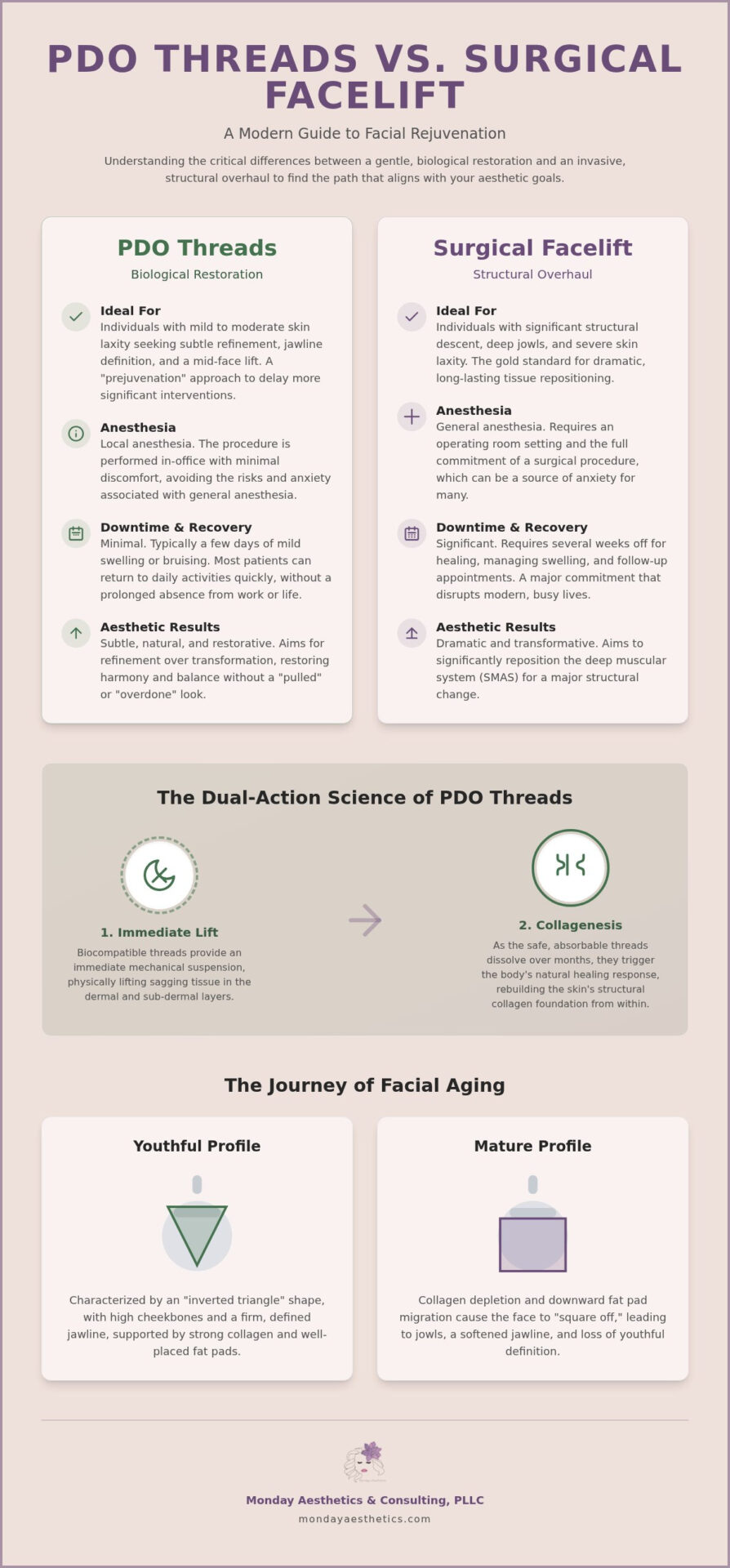
Facial aging is a quiet, gradual process that involves much more than the appearance of fine lines on the surface. It is a fundamental shift in the facial architecture where the scaffolding of the skin begins to soften. The primary drivers of this change are the steady depletion of collagen and the downward migration of deep fat pads. When these structural supports weaken, the youthful “inverted triangle” of the face begins to square off, leading to the formation of jowls and a softened jawline. The choice between PDO threads vs surgical lift treatments often begins with a quiet observation in the mirror as these subtle shifts become more apparent.
There is a specific “tipping point” in the aging process where the skin’s natural elasticity can no longer resist gravity. For some, this manifests as mild skin laxity, characterized by a slight loss of definition along the cheeks or chin. For others, it progresses into structural descent, where the underlying tissues have significantly shifted. Understanding where you sit on this spectrum is essential. It allows for a restorative approach that respects your natural features rather than forcing a transformation that feels disconnected from your identity. Modern patients are moving away from the “pulled” or overly tight surgical looks of the past, preferring instead to restore harmony and balance.
The Evolution of Facial Rejuvenation
The philosophy of aesthetic care has undergone a profound transformation. In previous decades, the “wind-tunnel” effect of aggressive surgery was often the only solution offered to those seeking a refreshed appearance. Today, regenerative aesthetics focuses on biological health and subtle refinement. Non-surgical technology has advanced to a point where it can effectively close the gap for individuals experiencing early to mid-stage aging. Residents of the North Sound, particularly around Burlington, are increasingly seeking this “prejuvenation” approach. They are choosing to intervene early with thoughtful, minimally invasive steps to maintain their natural vitality and delay the need for more significant interventions later in life.
Mechanical Lift vs. Biological Restoration
The fundamental difference between these two paths lies in the methodology of the correction. While traditional surgical facelift techniques focus on the deep muscular aponeurotic system (SMAS) through excision and repositioning, non-surgical options take a more regenerative route. PDO threads address the dermal and sub-dermal layers by providing a physical suspension while simultaneously triggering the body’s healing response. This process doesn’t just lift; it restores the skin’s foundation from within. Facial laxity is a multifaceted loss of both volume and tension.
The Science of Suspension: How PDO Threads Redefine Rejuvenation
Polydioxanone, or PDO, is a material with a long and respected history in the medical field. Originally developed as a synthetic, absorbable suture for delicate cardiovascular surgeries, its safety profile is well-documented and trusted by practitioners worldwide. In the context of the PDO threads vs surgical lift conversation, this clinical history is vital. It means we’re using a material that the body knows how to process safely and predictably. Unlike permanent implants or the structural trauma of a full surgical procedure, PDO threads are designed to integrate with your biology and then gently fade away, leaving behind a stronger version of your own skin.
The true beauty of this treatment lies in its dual-action mechanism. When we discuss how a thread lift works, we look at both the immediate mechanical suspension and the long-term biological response. The initial lift is satisfying, but the secondary phase is where the real restoration happens. At Monday Aesthetics, our philosophy centers on building a foundation. We don’t view threads as a temporary shortcut, but as a strategic tool to reinforce the facial architecture before significant sagging occurs. This NP-led approach prioritizes precision and safety, ensuring that every placement is intentional and supportive of your natural expressions.
Collagenesis: The Hidden Benefit of PDO
As the threads reside in the dermal layers, they act as a gentle irritant that triggers the body’s natural healing cascade. This results in the production of Type I and Type III collagen, creating a biological “scaffold” that remains even after the thread has been absorbed. Typically, the sutures dissolve within six to nine months, yet the structural improvements can persist for much longer. This regenerative effect makes threads an ideal partner for other volume-restoring treatments. For instance, pairing threads with Sculptra for facial volume can address both the descent of tissue and the loss of deep-seated fullness.
Target Zones: Where Threads Excel
When evaluating the PDO threads vs surgical lift path, it’s helpful to look at specific areas of concern. Threads are particularly effective where the skin has begun to drift but still retains some elasticity. They excel at refining the jawline, where they can soften the appearance of jowls and restore a crisp, clean profile. The mid-face also benefits immensely, as a subtle lift here can return the “triangle of youth” to its rightful position. For those seeking a brighter, more open expression, a PDO thread brow lift offers a non-surgical way to elevate the brow line. If you’re curious about how these techniques might enhance your own features, we invite you to explore a personalized consultation to map out your restorative journey.
PDO Threads vs Surgical Facelift: A Comparative Analysis
Choosing between a PDO threads vs surgical lift is often a decision about how much of your life you’re willing to pause. A surgical facelift is a significant medical commitment. It typically requires hospital-based general anesthesia and a recovery period that spans three weeks before most patients feel comfortable in social settings. In contrast, PDO threads are performed in a serene office setting using only local numbing. Most individuals return to their daily rhythm within 48 hours. This difference isn’t just about time; it’s about the intensity of the experience and the physical toll on the body’s systems.
While a surgical lift offers a structural result that can last a decade, it comes with the permanence of incisions and the potential for tell-tale scars. Threads offer a more ephemeral, yet remarkably natural, grace. The results typically cycle every 12 to 24 months as the body naturally processes the sutures. This shorter cycle isn’t a drawback for everyone. It allows the treatment to evolve alongside your face as you age, avoiding the static or “frozen” look that can sometimes follow a one-time surgical event. It’s a philosophy of continuous, gentle maintenance rather than a single, drastic correction.
Recovery Realities for the Busy Professional
For the active professional in Skagit County, time is a precious resource that’s rarely available in multi-week blocks. “Social downtime” for thread patients usually involves minor swelling or perhaps a small bruise that’s easily concealed. You won’t face the strict post-surgical bans on exercise, sun exposure, or heavy work commitments that surgery demands. Many Burlington residents prefer this “stealth” rejuvenation. It allows them to refresh their appearance without the obvious signs of having “work done” or the need for an extended absence from their community and career.
Risk Assessment and Patient Safety
Every aesthetic procedure carries its own set of considerations, and understanding them is the first step toward confidence. With threads, common side effects are limited to temporary bruising or a slight tugging sensation that resolves quickly. Surgical complications can be more systemic due to the nature of invasive cutting and the risks inherent to general anesthesia. Precision is paramount in non-surgical care. Choosing a board-certified provider ensures that threads are placed with an expert understanding of facial anatomy. One of the greatest advantages of threads is the ability to make incremental adjustments. Instead of one permanent change, you can refine your look gradually, maintaining your authentic character through every stage of life.
Identifying Your Ideal Treatment Path: Is It Time for Threads or a Lift?
Determining the right moment to transition from topical care to structural intervention is a deeply personal process. While chronological age is often cited in the PDO threads vs surgical lift debate, your skin’s biological quality and your personal lifestyle are far more accurate guides. A simple yet effective clinical marker used during a consultation is the “pinch test.” By gently pinching the skin on the cheek or jawline and observing how quickly it returns to its natural position, we can assess your current elasticity. If the “bounce-back” is swift, your skin still possesses the resilience to respond beautifully to the collagen-stimulating effects of threads.
Beyond the physical, there is a psychological component to this choice. Some individuals seek a “new you”, which is a dramatic structural reset that surgery provides. Others prefer a “restored you”, a version of themselves that looks rested, refined, and entirely authentic. This preference for restoration over transformation often dictates the path. Budgetary considerations also play a role; while threads require a lower initial investment, they represent a commitment to ongoing maintenance. Surgery is a significant upfront event intended to last a decade, requiring a different level of financial and emotional readiness.
The Best Candidate for PDO Threads
The ideal candidate for this path typically experiences mild to moderate laxity. You might notice the very beginning of jowls or a slight heaviness in the brow area that makes you look tired when you feel vibrant. If you’re seeking a non-surgical brow lift to open your gaze without the tell-tale signs of surgery, threads offer an elegant solution. This approach is perfect for those who prioritize skin texture and natural movement. It’s for the patient who wants to look like themselves, only more refreshed and supported.
When Surgery is the Appropriate Choice
There are instances where the most honest recommendation is a surgical path. When there is significant skin redundancy or severe volume loss that threads cannot realistically support, a surgeon can reposition the underlying SMAS muscle layer. This is for the patient seeking a one-time, definitive solution and who has the capacity for a three-week recovery period. We believe in transparency; threads are a powerful tool for restoration, but they aren’t intended to replace the structural excision required for advanced aging. If you’re ready to see which path aligns with your unique features, we invite you to schedule a consultation at our Burlington clinic to map out your journey.
The Art of the Subtle Lift at Monday Aesthetics
At Monday Aesthetics, we believe that true restoration is an art of subtlety. Led by Thea Anderson, NP, our practice is founded on the principle that aesthetic care should enhance your natural character rather than mask it. When navigating the PDO threads vs surgical lift decision, our focus remains steadfastly on precision and safety. We understand that residents of Burlington and the surrounding North Sound area value results that look effortless and refined. This NP-led approach ensures that every thread is placed with an intimate understanding of facial anatomy, prioritizing a gentle touch that minimizes discomfort and maximizes harmony.
A bespoke plan often involves more than a single modality. We frequently find that threads provide the necessary structural support, while other treatments address the finer details of light and shadow. For example, combining a lift with under eye filler can brighten a tired gaze, while integrating SkinVive hydration ensures the skin surface reflects a healthy, internal radiance. This holistic view of the face allows us to achieve a balanced result that a single surgical procedure might overlook.
A Serene Consultation Experience
Choosing a restorative path should never feel hurried or clinical. Our Burlington clinic is designed to feel like a retreat, a space where you can speak openly about your goals and concerns. We utilize a “philosophy-then-action” method. First, we establish a foundational belief about your care, then we map out the practical application. This personalized mapping ensures that thread placement is tailored to your unique bone structure and tissue quality, honoring the nuances of your face and ensuring your results feel entirely like you.
Long-Term Skin Health in Skagit County
Living in the Pacific Northwest means our skin faces unique environmental factors. To protect your investment and maintain the longevity of your results, we offer Monday Memberships. These programs make consistent, high-quality care accessible and predictable. By integrating professional skin care and regular maintenance, we help you sustain the vibrant, lifted appearance achieved through your treatment. It’s a partnership in your long-term well-being that prioritizes the health of your skin as much as its appearance. We invite you to begin your journey toward subtle restoration with a consultation at Monday Aesthetics.
Embracing Your Journey Toward Refined Restoration
Choosing between a PDO threads vs surgical lift is ultimately a decision about how you wish to honor your unique features as they evolve. While surgery offers a definitive structural shift, the regenerative power of PDO threads provides a sophisticated path for those who value authenticity and minimal interruption to their lives. By focusing on biological health and subtle suspension, you can restore a sense of harmony that feels entirely natural and distinctly yours. This approach allows for a graceful evolution, ensuring your results remain in balance with your facial architecture over time.
Our Burlington-based practice, led by Thea Anderson, NP, prioritizes your long-term well-being through specialized, natural-looking results and the ongoing support of our Monday Memberships. We believe that aesthetic care should be a steady, intentional partnership rather than a series of drastic changes. We invite you to Schedule Your Serene Consultation at Monday Aesthetics to discover which restorative path aligns with your specific aesthetic goals and daily rhythm. Taking this first step allows you to move forward with quiet confidence, knowing your care is in expert hands.
Frequently Asked Questions
How long do PDO threads actually last compared to a facelift?
When comparing PDO threads vs surgical lift longevity, threads typically provide results that last between 12 and 24 months, while a surgical facelift can offer a decade of structural change. The threads themselves are absorbed by the body within six to nine months, but the biological scaffold of new collagen they stimulate extends the visible lift. This shorter cycle allows for a more flexible, evolving approach to aging that respects your natural features.
Can PDO threads be seen or felt under the skin?
When placed with precision by an expert practitioner, PDO threads are neither visible nor palpable once the initial healing phase concludes. During the first week, you might notice a slight tugging sensation as the tissues begin to integrate with the sutures. We prioritize a delicate technique to ensure that the threads reside deeply enough to provide structural support without disrupting the smooth, natural texture of your skin surface or your natural expressions.
What is the ‘social downtime’ for a PDO thread treatment in Burlington?
Most patients in the Burlington area find that social downtime for a PDO thread lift is minimal, usually lasting about 48 hours. You may experience light swelling or minor bruising that is easily managed with mineral makeup or simple rest. Unlike the three week recovery often required for surgery, this non-surgical path allows you to return to your community and professional commitments almost immediately, maintaining a sense of privacy regarding your care.
Are PDO threads safer than going under general anesthesia for surgery?
PDO threads are performed under local numbing in a serene office setting, which eliminates the systemic risks associated with general anesthesia. Avoiding a hospital based surgical environment reduces the physical toll on your body and simplifies the recovery process. While every procedure requires a careful assessment of history and health, the non-invasive nature of threads offers a reassuring safety profile for those who prefer a less intensive and more controlled restorative journey.
Can I combine PDO threads with Botox or fillers?
Combining PDO threads with other modalities like Botox or dermal fillers is often the most effective way to achieve a harmonious result. While threads provide the necessary suspension and lift, fillers can restore lost volume and Botox can soften dynamic expression lines. This multi-layered approach addresses facial aging from several angles, creating a balanced, refreshed appearance that a single treatment type might not fully capture on its own during a single visit.
Is a thread lift painful during the procedure?
We prioritize your comfort by using advanced local numbing techniques before the procedure begins. Most patients describe the sensation as a feeling of pressure or a slight tugging rather than acute pain. Our goal is to create a serene, supportive environment where you feel relaxed throughout the process. Thea Anderson’s gentle touch ensures that the experience feels more like a focused wellness treatment than a clinical intervention, allowing for a peaceful experience.
What happens if I decide I want a surgical lift later on?
Choosing a thread lift now does not preclude you from opting for a surgical facelift in the future. Because PDO threads are fully absorbable and focus on building natural collagen, they don’t create the extensive scarring or structural changes that would interfere with later surgery. Many patients view threads as a sophisticated way to manage early aging, allowing them to delay more invasive procedures until they feel truly ready for a permanent surgical change.
How much does a thread lift cost compared to a traditional facelift?
When evaluating the investment of PDO threads vs surgical lift options, threads represent a more accessible initial commitment. While surgery involves significant costs for hospital facilities and anesthesia, thread treatments focus purely on the expertise of the practitioner and the quality of the materials used. Although threads require periodic maintenance to sustain results, they offer a flexible financial path for those who value a non-surgical, regenerative approach to their facial rejuvenation journey.