What if natural-looking Botox results are less about smoothing every line and more about understanding how your face moves? The goal can be to soften selected expression lines while preserving the gestures and character that make your face yours.
If you’re concerned about looking stiff or unlike yourself, that hesitation is understandable. Facial muscles move differently from person to person, so treatment decisions should reflect your expressions, features, and preferences rather than a one-size-fits-all ideal. A thoughtful plan can aim for a subtle change, though individual results vary.
This guide explains what can contribute to a balanced outcome, what to discuss during an individualized assessment, and how to set realistic expectations. You’ll also learn how to interpret before-and-after images and describe the movement you’d like to keep. At Monday Aesthetics & Consulting in Burlington, board-certified Nurse Practitioner Thea Anderson offers Botox as part of an individualized approach to aesthetic care. The goal is not to change your expression, but to make informed choices that feel aligned with it.
Key Takeaways
- Natural looking Botox results can soften expression lines without requiring a completely line-free look.
- Facial movement, individual features, preferences, and treatment decisions all shape how results appear.
- Describe the changes you hope to see and the expressions or features you want to preserve during your treatment conversation.
- Share relevant medical history and questions with your treating clinician to support a thoughtful discussion of your options.
- Monday Aesthetics & Consulting offers Botox in Burlington, Washington, with an individualized approach to aesthetic care.
What Do Natural-Looking Botox Results Really Mean?
Natural-looking results don’t require a perfectly smooth forehead or the disappearance of every crease. They’re about how a change fits your features: lines may look softer while your face remains familiar when you smile, concentrate, or raise your brows. Some lines can remain visible and the result can still feel subtle, because the aim is a considered change rather than a uniform finish.
Natural-looking Botox results soften selected expression lines while respecting the facial movement and features that make each person recognizable. “Natural” isn’t a fixed level of smoothness, and it doesn’t mean everyone should have the same amount of movement or line reduction. Your anatomy, expressions, and preferences all shape what subtle means for you.
How can Botox soften lines without changing your expression?
Facial expressions involve muscles moving beneath the skin. Botox acts on communication between nerves and targeted muscles; the Botulinum toxin overview describes this mechanism and its medical and cosmetic uses. Treatment goals can focus on selected lines that appear with particular expressions, rather than pursuing an identical look across the whole face.
For example, you might want a line between your brows to look less pronounced when you concentrate while still valuing visible brow movement. Or you may be more concerned about forehead lines when you raise your eyebrows. These are conversation starters, not promises of specific results. A refreshed appearance can retain signs of expression; it doesn’t have to mean a blank or uniform face.
Why is “natural” a personal aesthetic goal?
People have different ideas of balance. You may prefer light softening and plenty of visible movement, while someone else may want a more noticeable reduction in certain lines and unchanged movement elsewhere. Facial anatomy also differs, so the same treatment plan may not create the same appearance for everyone.
During a treatment conversation, describe both sides of your goal: what you’d like to soften and what you want to preserve. You might mention your familiar smile, expressive brows, or the way your face looks when you’re listening. These details are more useful than simply asking to “look natural.”
Think beyond a single photograph, too. Your face changes as you speak and respond, while a still image captures only one moment. Instead of comparing yourself with a filtered image or another person’s result, consider which features feel essential to your expression. A meaningful outcome reflects your priorities, not a universal beauty standard.
Subtlety isn’t measured by how little treatment someone receives or how few lines remain. It comes from setting a clear, personal goal and discussing how your facial movement and features relate to it. Keeping that definition in mind can help you explain what “still looking like me” means before treatment planning begins.
How Botox Treatment Planning Can Support Subtle Results
A thoughtful plan starts with more than naming a line or treatment area. Botox works by affecting nerve signals to targeted muscles, which can temporarily reduce their activity. Since facial muscles contribute to expressions as well as visible lines, planning involves considering what you’d like to soften and how you want your face to move.
The same Botox approach may not suit every face because facial anatomy, movement, and aesthetic priorities differ. Treatment planning should follow an individual assessment and a clear conversation about your goals, rather than a standard template or a promise of a particular look.
How facial movement informs a personalized plan
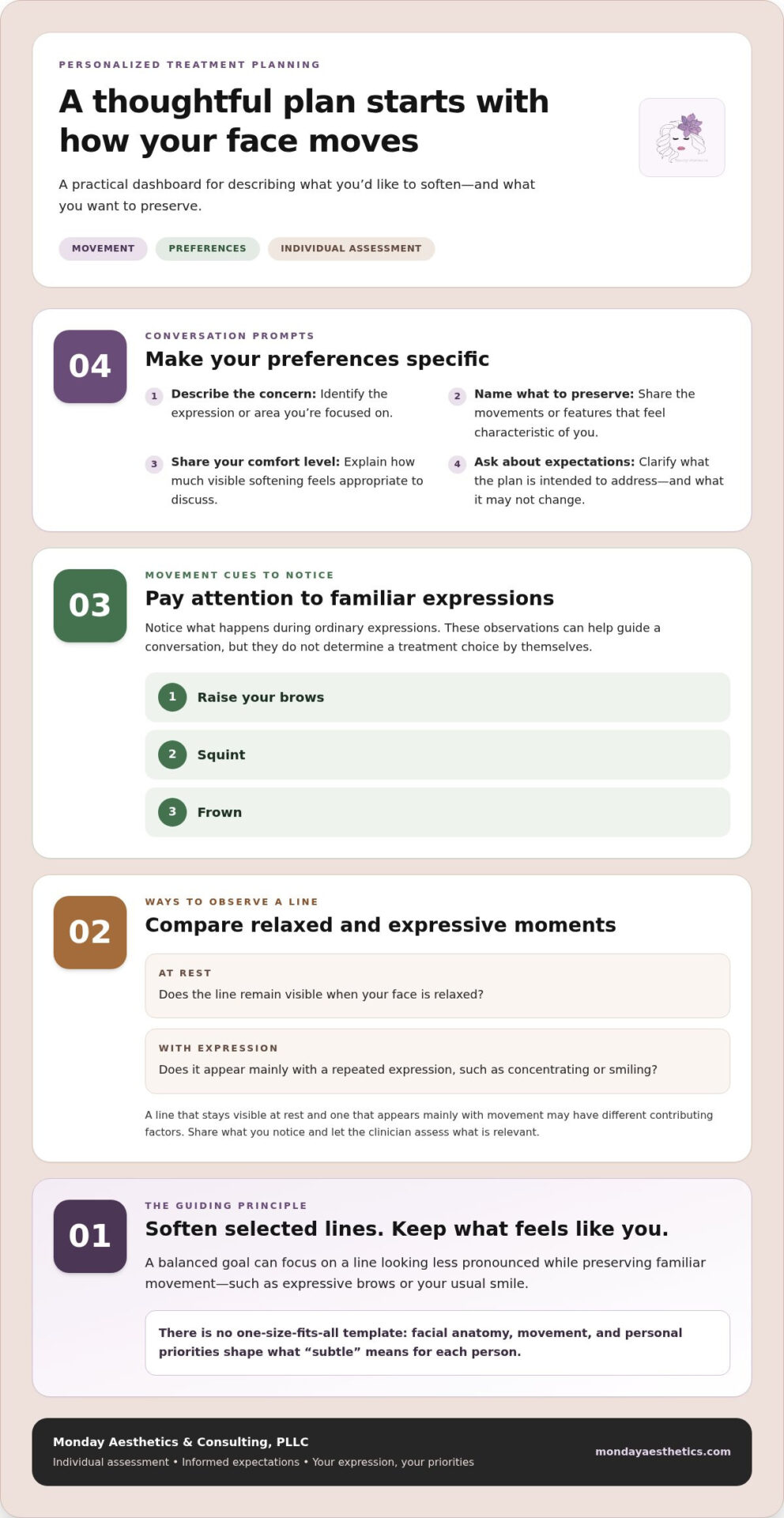
A clinician may consider your face at rest and as you make expressions. Notice what happens when you raise your brows, squint, or frown. Does a line appear mainly during movement, or does it remain visible when your face is relaxed? This observation can help guide the discussion, but it doesn’t determine a treatment choice by itself.
Some concerns may need a separate assessment rather than being assumed to respond to Botox. A line that remains visible at rest and one that appears mainly with a repeated expression may have different contributing factors. Share what you notice during ordinary activities, such as concentrating or smiling, and let the clinician assess what may be relevant.
What should you communicate about your preferred result?
Describe both the change you hope for and the expression you want to keep. Rather than saying only “smooth this area,” you might explain that you’d like a line to look less prominent while keeping your brows expressive. Be candid if stiffness, an obvious treatment effect, or too much change is a particular concern.
These details make the conversation specific while leaving clinical decisions to the treating clinician. Discuss what may be realistic for your features and movement, and ask questions if the proposed plan doesn’t match what you had in mind.
- Describe the concern: Identify the expression or area you’re focused on.
- Name what to preserve: Mention movements or features that feel characteristic of you.
- Share your comfort level: Explain how much visible softening feels appropriate to discuss.
- Ask about expectations: Clarify what the plan is intended to address and what it may not change.
Monday Aesthetics & Consulting in Burlington offers Botox as part of its injectable services. If you’re considering treatment, explore Botox treatment discussions as a starting point for thinking through your goals and questions.
Why Botox Results Vary, and What ‘Frozen’ Really Means
The fear of looking “frozen” often comes from imagining Botox as an all-or-nothing change. That isn’t the only treatment goal. The appearance and degree of movement after treatment can differ with facial anatomy, muscle movement, the areas being considered, treatment decisions, and personal preferences. No single factor explains every result, and a natural-looking outcome can’t be guaranteed.
For one person, “frozen” may mean brows that feel less expressive than expected. For another, it may describe a look that seems unfamiliar in a photograph. Naming the specific concern is more useful than treating the word as a precise clinical description. It gives you and your clinician a clearer starting point for discussing what you’d like to preserve and what changes may be realistic.
Can you still look expressive after Botox?
That depends on the person and treatment plan, so discuss it directly rather than making assumptions. Before treatment, think about which expressions feel most like you: perhaps your brows moving when you’re surprised, or your eyes narrowing slightly when you smile. These examples turn a general wish to “keep expression” into a more personal conversation.
Share any concern that your movement could feel limited or your appearance could change more than you’d like. A clinician can assess your features and discuss the intended effect and possible limitations. Avoid relying on absolute assurances. The goal is a shared understanding of what matters to you, not a promise that every expression will remain exactly the same.
How to interpret Botox before-and-after photos
Photos can illustrate one person’s experience, but they can’t predict precisely how you’ll respond. Comparisons are easier to interpret when the images use consistent lighting, camera angle, distance, facial expression, and timing. A relaxed face compared with a deliberately raised brow, for example, may make a change look greater or smaller than it is.
Look for context alongside the images: which areas were treated, what the person hoped to address, and whether the photographs show comparable expressions. Published patient images should be shared with appropriate consent and context. Even then, they show one person’s experience, not a template for your own.
- Read the expression: Notice whether both images show the same movement or a relaxed face.
- Check the comparison: Consider changes in lighting, angle, and framing before judging the difference.
- Keep individuality in view: Another person’s features and treatment experience can’t tell you exactly what your result will look like.
Consider natural looking Botox results in light of both your personal goals and a clinical assessment, rather than a single image or the label “frozen.” Honest expectations leave room for individual variation while keeping the conversation focused on the expressions and features you value.
How to Prepare for a Natural-Looking Botox Conversation
A focused conversation can help translate “I want to look refreshed” into goals a clinician can assess. You don’t need technical language or a complete treatment plan. Think about what draws your attention, how your face moves in everyday moments, and what you’d like to remain unchanged. This preparation clarifies your preferences; it doesn’t mean you need to decide what treatment you want.
If you’re looking for details about what to expect from an appointment, the Botox consultation experience can help you understand the conversation. The checklist below offers a practical way to organize your thoughts before discussing your goals with the treating clinician.
A simple checklist for describing your aesthetic goals
Work through these prompts in order. Specific observations are often more useful than a broad request for a certain look.
- Identify what you’d like assessed. Note the lines or expressions you’ve been thinking about, and when you notice them, such as while concentrating, smiling, or raising your brows.
- Name what you want to preserve. Consider features or movements that feel characteristic of you. You might want to keep expressive brows or your familiar smile while discussing a particular concern.
- Describe your comfort level. Explain whether you’re hoping for light softening or a more noticeable change, and share any worry about stiffness or looking visibly treated.
- Use reference images thoughtfully. Bring images if they help explain the quality of a result you like, but treat them as conversation aids, not exact-result requests. Different facial features and movement mean an image can’t reliably predict your result.
Preparation complements, but doesn’t replace, a clinical assessment. The clinician needs to consider your individual features and circumstances before discussing what may be appropriate.
What to discuss about expectations and follow-up
Bring your questions, including those that feel small. Ask what changes a proposed plan is intended to address, what it may not change, and what follow-up guidance applies to your individual care. Share relevant medical history with the treating clinician and mention health-related concerns that could affect the discussion. Personalized treatment guidance should come from the clinician assessing you, not from a photo or another person’s experience.
Before you finish the conversation, make sure you understand the intended goal. If preserving a particular expression is a priority, say so directly. If an explanation doesn’t address your concern, ask for clarification before deciding whether to proceed.
If you’re thinking about broader, ongoing aesthetic care, the aesthetic membership guide offers related information. To explore Monday Aesthetics & Consulting’s approach to Botox and personal aesthetic goals, learn about the practice.
A Thoughtful Approach to Botox in Burlington, WA
For people considering Botox in Burlington, the conversation can start with a simple question: what would you like to notice while still looking like yourself? Monday Aesthetics & Consulting offers Botox as part of its injectable services. The practice is owned and operated by Thea Anderson, a board-certified Nurse Practitioner. Monday Aesthetics & Consulting welcomes people from Burlington and nearby communities, including Sedro-Woolley, Mount Vernon, Stanwood, Arlington, Marysville, Bellingham, Lynden, Everett, Anacortes, Oak Harbor, and La Conner.
Natural looking Botox results are a personal goal, not a standard that can be applied identically to every face. A measured discussion makes room for your concerns, the expressions you value, and realistic expectations. Explain what you hope to soften, what you want to preserve, and what would feel like too much change. The clinician can then assess your features and discuss whether Botox fits the concern you’ve described.
How an individualized approach respects your features
An individualized approach starts with listening. A line that draws one person’s attention may not matter to someone else, and the expressions people want to retain differ, too. During a treatment conversation, describe how your face moves in everyday situations and what “subtle” means to you. You might want a particular line to appear softer while keeping a familiar quality in your brows or smile.
It’s reasonable to mention if you’re anxious about stiffness, an obvious treatment effect, or looking unlike yourself. Those preferences help frame the discussion, while an assessment helps establish what may be realistic for your features. No description or photo can guarantee a particular result, so the aim is shared understanding before decisions are made.
When Botox may not address every concern
Not every concern is primarily about expression lines. If what you notice relates more to brow position or facial structure, it may call for a different treatment discussion. Identifying the concern accurately is an important first step, since Botox shouldn’t be presented as a solution for every change in facial appearance.
For readers curious about a separate option related to brow position, the PDO thread brow lift guide discusses that treatment topic. Any decision should follow an individual assessment and a clear conversation about goals, possible limitations, and relevant options.
Monday Aesthetics & Consulting focuses on a thoughtful, individualized aesthetic conversation grounded in your preferences and realistic expectations. If you’re in Burlington or a nearby community and considering Botox, explore Botox care at Monday Aesthetics and begin a discussion about the result you hope to achieve while honoring the features that feel most like you.
Take the Next Step at Your Own Pace
Choosing an aesthetic treatment doesn’t need to begin with a decision. It can begin with curiosity: what would you like to feel more at ease about, and which parts of your expression feel important to keep? Taking time to consider those questions can make a future conversation more focused and personal.
Natural looking Botox results aren’t about meeting someone else’s idea of perfection. They start with a goal that feels true to you and a thoughtful discussion about whether treatment may align with it. Take time to ask questions, share concerns, and decide what feels right without rushing toward a particular outcome.
Monday Aesthetics & Consulting is based in Burlington, Washington, and offers Botox among its cosmetic injectable services. The practice is owned and operated by Thea Anderson, a board-certified Nurse Practitioner. Explore Botox care at Monday Aesthetics to discuss whether treatment may fit your goals. A considered first step can help you move forward with clarity.
Frequently Asked Questions
Can Botox look natural?
Yes, Botox can be approached with a natural-looking goal, though no specific appearance can be promised. For some people, that means softening selected lines while keeping their features recognizable; for others, it means prioritizing visible movement. Anatomy, facial movement, preferences, and clinical decisions all influence outcomes. If you’re considering treatment, describe what would feel like a suitable change and ask a qualified clinician what expectations are realistic for you.
Will I still be able to move my face after Botox?
The amount of movement you’d like to retain is a topic to discuss before treatment, not something that can be guaranteed in advance. For example, you might be comfortable with a softer frown line but want your brows to remain expressive. Your goals, natural facial movement, and the clinician’s assessment inform the plan. Be specific about which expressions matter most to you, and ask how those preferences factor into treatment decisions.
How long does it take to see Botox results?
Timing varies, so ask your treating clinician what to expect for the treatment being discussed. Don’t judge the appearance immediately after an appointment, since that moment may not show the eventual effect. If you’re comparing how an area looks over time, note when you first observe a change and share your observations at any planned follow-up. Your clinician can help interpret your experience without relying on a fixed timeline.
How long do natural-looking Botox results last?
Natural looking Botox results don’t have one guaranteed duration. How long an effect remains noticeable can vary with the treatment and individual factors, so another person’s maintenance schedule may not suit you. Ask your clinician what longevity may be reasonable in your case and when to discuss follow-up. A personal maintenance plan is a way to review your goals over time, not a promise that results will last for a set period.
Can Botox prevent wrinkles from forming?
Botox isn’t a guarantee against future wrinkles. It may be discussed for selected expression-related concerns, but that doesn’t mean it will prevent every line or have the same role for everyone. If prevention is part of your interest, explain your appearance goals and ask a qualified clinician whether treatment is appropriate for you. Make decisions based on an individual assessment and current medical guidance, rather than broad claims or online trends.
What should I do if my Botox result looks uneven?
Contact the clinician who treated you and describe what looks uneven, rather than trying to correct it yourself. The timing of your concern and your individual response can matter, and a clinician needs to assess the result before advising on next steps. If possible, explain when you first noticed the difference and whether it changes with facial movement. Avoid seeking additional treatment based only on a photo or someone else’s experience.
Are there side effects to Botox?
Yes, cosmetic injections can involve side effects and other risks. Before treatment, ask a qualified clinician to review current safety information, including what effects may be expected and which concerns warrant medical attention. Share relevant medical history and any questions that could affect your decision. If you experience serious or unexpected symptoms after treatment, seek prompt medical attention and inform the treating clinician. This guidance doesn’t replace individualized medical advice.