
If you’re wondering how long does Botox take to work, it can be unsettling to see little change a few days after treatment and wonder whether it has taken effect. Botox doesn’t usually create an immediate visible change. Its effects develop gradually as the treated muscles respond.
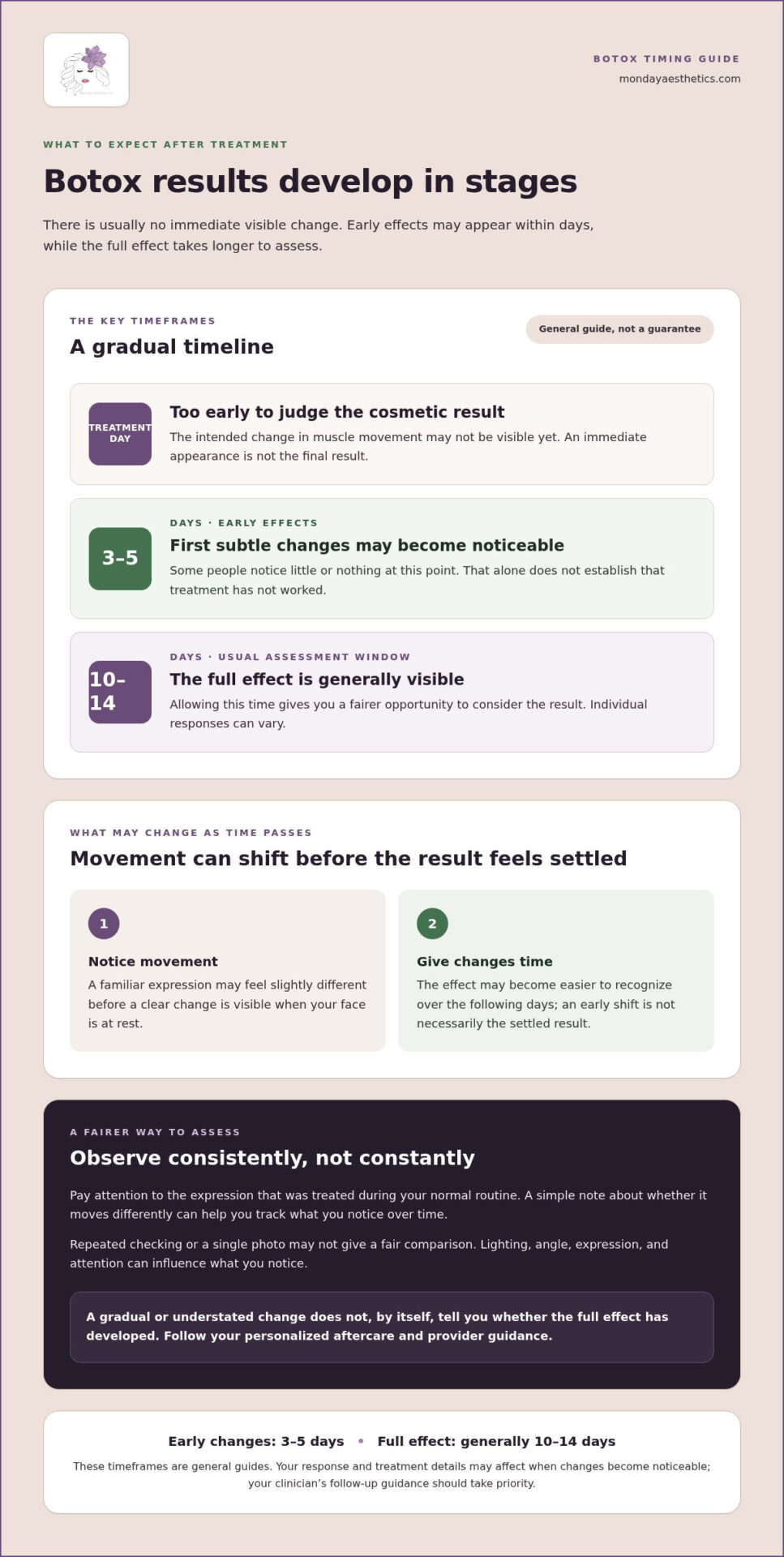
Initial effects are often noticeable within 3 to 5 days, while the full result generally becomes visible within 10 to 14 days. That timeline is a guide, not a promise: individual responses vary, and subtle early changes don’t necessarily mean treatment hasn’t worked. Giving the results time to develop can help you assess them more fairly.
This article explains what you may notice in the days after treatment, when results are usually ready to evaluate, and which factors can influence your experience. You’ll also learn when it makes sense to discuss your progress with a qualified provider. At Monday Aesthetics in Burlington, board-certified Nurse Practitioner Thea Anderson offers Botox and individualized guidance based on your goals and response, rather than a one-size-fits-all timeline.
Key Takeaways
- Wondering how long does Botox take to work? Early changes may appear within 3 to 5 days, while a fair assessment of the full effect generally takes 10 to 14 days.
- No visible change right away doesn’t necessarily mean treatment failed; results can develop gradually.
- Your individual response and treatment details may affect when changes become noticeable, so timelines aren’t guarantees.
- Follow your personalized aftercare guidance, give results time to develop, and discuss concerns at your advised follow-up.
- At Monday Aesthetics in Burlington, board-certified Nurse Practitioner Thea Anderson provides Botox care with individualized clinical guidance.
How long does Botox take to work, and when might you notice a change?
If you’re asking how long does Botox take to work, the first noticeable changes often appear within a few days. It generally takes longer to judge the full effect. Botox isn’t expected to create an immediate visible difference after treatment. Your response may develop at a different pace from someone else’s, so treat these timeframes as a general guide, not a personal guarantee.
For cosmetic Botox, initial effects are commonly noticeable within 3 to 5 days, while the full effect is generally visible within 10 to 14 days. This is a typical timeframe, not a prediction of the exact day your results will appear. Botox temporarily affects the muscle activity involved in certain expressions. The mechanism of botulinum toxin helps explain why the visible change develops over time rather than appearing all at once.
Early changes versus the full Botox result
“Onset” means the first change you notice in movement or appearance. A familiar expression might feel slightly different before you see a clear change when your face is at rest. That early shift isn’t necessarily the settled result. The effect can continue to develop, and people don’t all notice it on the same day. Waiting until the usual assessment window gives you a more balanced basis for evaluating your response.
Why a gradual change can feel subtle
Small differences can be difficult to spot when you see your face every day. You might notice them more when making a familiar expression, such as raising your eyebrows or frowning, than when looking at your face at rest. Observe your expressions over time instead of checking repeatedly throughout the day. Frequent comparisons can make subtle changes feel uncertain, while a calm, consistent perspective helps keep expectations realistic.
The goal of assessment isn’t to look for a dramatic transformation. Botox affects muscle movement, and the visible result depends on your individual response and treatment details. A gradual or understated change doesn’t, by itself, tell you whether the full effect has developed. Give the process time and consider your progress in the context of the treatment plan discussed with your clinician.
It can help to note what you observe in a simple, consistent way. For example, record whether a particular expression seems to move differently than it did before treatment. Avoid treating a single moment or photograph as definitive evidence. Lighting, angle, expression, and attention can all influence what you notice, so an immediate visual comparison may not give you a fair assessment.
If you’re unsure whether your progress fits your treatment plan, seek individualized guidance rather than relying on online timelines alone. At Monday Aesthetics in Burlington, board-certified Nurse Practitioner Thea Anderson provides Botox care and guidance tailored to each person. An assessment considers your response, not just a calendar estimate.
What happens after Botox? A simple timeline from treatment to full effect
Botox results unfold in stages, so treatment day is too early to judge the cosmetic effect. A useful general timeline is: no immediate visible change is expected; early effects may become noticeable over the next several days; changes can continue to develop; and the result is usually more appropriate to assess around two weeks after treatment. Individual responses vary, and your clinician’s follow-up guidance should take priority.
- Treatment day: The injections are complete, but the intended change in muscle movement may not be visible yet. Don’t use how your face looks immediately afterward to judge the final result.
- Early days: You may notice the first subtle difference within about 3 to 5 days. Some people notice little or nothing at this point, which alone doesn’t establish that treatment hasn’t worked.
- Developing changes: The effect may become easier to recognize over the following days. A change in movement can be noticeable before the overall appearance feels settled.
- Assessment window: The full effect is generally visible within 10 to 14 days. Allowing this time gives you a fairer opportunity to consider the result.
The first few days after treatment
In the first few days, patience matters more than close inspection. You may see no cosmetic difference on treatment day because Botox’s effect develops rather than appearing instantly. Temporary marks or sensations around injection sites aren’t proof of the cosmetic result. Focus on your usual expressions, and follow the aftercare instructions you were given instead of trying to judge the outcome from immediate changes.
When the result is more appropriate to assess
Assessment is more meaningful after the effect has had time to develop. Botox effects are generally fully visible within 10 to 14 days, although that timeframe isn’t a guarantee for everyone. If your provider has recommended a particular follow-up schedule, use that guidance to frame your assessment. A clinician can consider your treatment and individual response more thoughtfully than a day-by-day comparison alone.
In brief: Early changes may emerge around days 3 to 5. Allow about 10 to 14 days for the full effect to become visible before evaluating your result.
Rather than checking your face repeatedly, choose a calm, consistent way to notice changes, such as paying attention to the expression treated during your normal routine. If you reach the recommended assessment window and remain uncertain, bring your observations to your provider. For individualized Botox guidance in Burlington, learn about Botox care at Monday Aesthetics, where board-certified Nurse Practitioner Thea Anderson offers care that recognizes individual differences in response and timing.
Why Botox onset differs from person to person
There isn’t one exact start date that applies to everyone. The timing of a noticeable change can reflect your individual response and treatment details, including the muscles addressed. These influences don’t combine into a reliable formula, so they can’t predict the day you’ll see a difference. A general timeline is useful context, not a diagnosis of your individual result.
Treatment area and individual response
Facial muscles differ in strength, position, and role in expression. The way your brow moves, for example, may make a subtle change easier or harder to notice than movement around the eyes. That describes what you observe, not a dependable rule that one treatment area always responds before another. Your usual expressions and personal perception also shape when a change feels apparent.
For a fair comparison, notice the specific movement discussed during your treatment rather than looking for a uniform change across your face. One person might recognize a difference while making an expression; another may need more time before the change feels clear. Neither observation alone sets a universal standard for success.
Dose, treatment history, and other proposed factors
Treatment planning is individualized and clinician-directed. The muscles being treated, their movement, and the planned dose can affect the intended degree of change in muscle activity, but they don’t provide a precise onset forecast. Your clinician considers these details together rather than using a single factor to promise a particular result or start date.
Metabolism, age, skin condition, and previous treatment are also sometimes mentioned as possible influences. They shouldn’t be treated as a simple explanation for an individual timeline. Without a clear clinical assessment, it’s difficult to identify why one person notices a change sooner than another. These factors don’t allow a reliable calculation of when Botox will take effect.
Keep these distinctions in mind:
- Visible change is personal: Facial movement and how closely you observe it can shape what you notice.
- Treatment details matter: Area and dose are part of a clinician’s plan, not variables to adjust on your own to speed up results.
- Timing alone can’t confirm the outcome: A general estimate can’t determine whether a particular treatment has worked as intended.
Most importantly, no visible change after one day doesn’t mean treatment failed. Botox isn’t expected to produce an immediate cosmetic effect, and an early check can’t establish the final outcome. If you’re concerned, note what you’re seeing and discuss it with your treating clinician at the appropriate assessment point. The question “how long does Botox take to work?” has a general answer, but understanding your own response calls for individualized guidance, not guesswork or a change in dose.
What to do while waiting for Botox to take effect
A measured approach can make the waiting period clearer: follow the aftercare instructions provided for your treatment, allow the effect time to develop, then assess your progress at the follow-up point your clinician recommends. Online timelines offer general context, but they can’t account for your treatment details or evaluate your individual response.
Keep your aftercare simple and specific to the guidance you received. If something you read online conflicts with those instructions, don’t add a home remedy or change your routine in an attempt to speed up or alter the result. Your treating clinician is the right person to advise you about your treatment plan.
How to observe progress without overchecking
Rather than inspecting your face throughout the day, record the treatment date and make brief observations at reasonable intervals. Note what you see in the expression or movement discussed during your appointment. If you compare photos, use similar lighting, angle, and facial expression so ordinary differences between pictures don’t distract from your observations.
Keep notes factual: “movement still feels similar when I raise my brows” is more useful than repeatedly judging whether the result looks right. This gives you a clear way to describe your experience at follow-up without assuming what it means. Don’t massage the treated area or try exercises, devices, or other interventions to change the effect unless your clinician specifically advises you to do so.
When to contact your treating provider
If you remain concerned after the assessment period your clinician advised, contact the treating provider and explain what you’re noticing. Include your treatment date, the area treated, when you first noticed any change, and whether the effect seems to be developing. This context makes a routine discussion about results more useful than relying on a general online timeline.
Routine questions about appearance or movement can be raised with your treating provider for individualized guidance. Serious or unexpected symptoms are different: seek urgent medical attention for difficulty breathing, swallowing, or speaking, or for symptoms that feel severe or rapidly worsen. Don’t wait for a cosmetic follow-up if you’re experiencing an urgent symptom.
A useful message can be brief: “I had treatment on [date]. I’ve noticed [specific change or no change] in [area] since then. Is this consistent with the follow-up plan?” You don’t need to diagnose the result yourself. Clear observations and the timing of your concerns give your clinician a helpful starting point.
For individualized Botox guidance in Burlington, learn about Botox care at Monday Aesthetics. Board-certified Nurse Practitioner Thea Anderson can discuss your concerns in the context of your treatment and response.
Botox timing at Monday Aesthetics: individualized guidance in Burlington
General timelines can help set expectations, but they can’t tell you exactly how your own Botox treatment will develop. Your facial movement, treatment area, goals, and response all matter. Timing is best understood alongside a conversation with a qualified clinician who can consider your individual circumstances rather than measure your experience against a standard result.
Monday Aesthetics is an aesthetic practice in Burlington, Washington, offering Botox. The practice is owned and operated by Thea Anderson, a board-certified Nurse Practitioner. Her clinical perspective can help put questions about treatment and progress in context, with the focus on your goals and an individualized approach.
A thoughtful conversation about your treatment goals
A useful discussion starts with what you’d like to address and what a satisfying, natural-looking change means to you. You might describe a particular expression that concerns you or explain that you want to preserve the character of your face while exploring a subtle adjustment. These details give your provider context for discussing whether your expectations align with an individualized treatment plan.
If you’ve already had Botox, describe what you’ve noticed since treatment. Clear observations are more useful than trying to decide on your own whether the result is right or wrong. Individualized clinical guidance can put those observations in context without promising a particular appearance or onset date.
A local next step for Burlington-area readers
Monday Aesthetics offers Botox care in Burlington, Washington, for people seeking a personal conversation about their goals. The practice serves the surrounding communities of Sedro-Woolley, Mount Vernon, Stanwood, Arlington, Marysville, Bellingham, Lynden, Everett, Anacortes, Oak Harbor, and La Conner. Care isn’t about fitting every person to the same timeline or outcome, but about considering individual needs and goals. Take time to understand the treatment and decide whether it feels appropriate for you.
Questions about how long does Botox take to work are a natural part of deciding what to expect. A general estimate can orient you, while a qualified provider can discuss your situation in its own context. There’s no need to rush toward a decision; thoughtful care begins with clear information and realistic expectations.
For a personal conversation about Botox in Burlington, explore Botox care at Monday Aesthetics.
Choose a next step that feels right for you
Understanding how long does Botox take to work can help set expectations, but your next step can be more personal than following a timeline. Consider what you hope to achieve, what feels important to preserve, and which questions would help you feel informed. A thoughtful conversation can make room for those priorities without assuming one approach or outcome suits everyone.
If you’re considering Botox in Burlington, Monday Aesthetics offers care led by Thea Anderson, a board-certified Nurse Practitioner. Explore the practice’s approach and decide whether learning more is right for you.
Explore Botox care at Monday Aesthetics and take the next step at your own pace. An informed choice can be a reassuring beginning.
Frequently Asked Questions About Botox Timing in Burlington, WA
Can Botox take effect within 24 hours?
Some people may notice an early change within the first day, but immediate visible results aren’t the usual expectation. An early shift is only one point in the process, not the complete cosmetic result. If you’re wondering how long does Botox take to work, don’t judge the outcome from a first-day check. Follow your treating provider’s guidance for assessing your individual response.
Can you make Botox work faster by exercising your facial muscles?
Don’t rely on facial exercises to make Botox take effect sooner. The change develops gradually, and exercising treated muscles isn’t a proven way to accelerate that process. Avoid trying to manipulate the result at home. If you have questions about a particular activity after treatment, follow the aftercare instructions you received or ask your treating provider for advice tailored to your treatment.
Does rubbing the injection area make Botox work faster?
No. Rubbing or massaging the treated area isn’t a proven way to change when Botox takes effect, so don’t do it to try to speed results. Follow your clinician’s aftercare instructions for handling the area. If it feels uncomfortable or you’re concerned about a change you’ve noticed, contact your treating provider for individualized guidance instead of applying pressure or trying a home remedy.
Can I wear makeup after Botox, and will it affect when results appear?
Makeup doesn’t determine when Botox takes effect, but when to apply it depends on your provider’s aftercare directions and how your skin feels after treatment. There isn’t one waiting period that applies to everyone. When you do apply makeup, handle the treated area gently and avoid pressing or rubbing it. If your instructions don’t address makeup, ask your treating provider for specific guidance.
Can Botox cause a headache before the results appear?
Some people report temporary symptoms, including a headache, after treatment. A headache doesn’t predict whether or when the cosmetic effect will appear, and it can’t establish the cause on its own. Contact your treating provider if it persists or concerns you. Seek urgent medical care for a severe or unusual headache, or for other serious symptoms such as difficulty breathing, swallowing, or speaking.
Does Botox work while you are asleep?
Sleep doesn’t switch Botox’s effect on or off; the treatment response develops gradually after injection. There’s no reason to expect a particular sleep position to make results appear faster. If you’re unsure about positioning or activity soon after treatment, follow the instructions your provider gave you rather than relying on a universal rule. This guidance applies whether you’re in Burlington or nearby Sedro-Woolley, Mount Vernon, Stanwood, Arlington, Marysville, Bellingham, Lynden, Everett, Anacortes, Oak Harbor, or La Conner.