What if a natural Botox result isn’t about keeping every line of movement, but about preserving the expressions that make your face yours? If you’re weighing the signs of good vs bad Botox, a smoother forehead or a change in brow position can raise questions, especially before results have fully settled.
It’s understandable to feel uncertain about reduced movement, bruising, heaviness, or asymmetry. Some changes may be expected, while others deserve a closer look. Noticing a difference doesn’t mean you need to diagnose it yourself. Balanced results generally soften targeted lines while leaving your face expressive and recognizably you.
This article explains how to recognize subtle, harmonious results, compare common aesthetic concerns with symptoms that need urgent attention, and decide what to do if something feels off. Timing matters when you assess your results, so we’ll also cover what to note before following up. At Monday Aesthetics & Consulting, PLLC in Burlington, Washington, Botox care starts with an individualized conversation and respect for your natural expression.
Key Takeaways
- Use the signs of good vs bad Botox to assess whether your results align with your goals and preserve balanced facial expression.
- Learn how targeted forehead and brow muscles influence movement, and why treatment planning is individual.
- Compare mild injection-site effects with aesthetic concerns and symptoms that warrant urgent medical attention.
- If results feel uneven, heavy, or overly restricted, document what you notice and contact the medical professional who treated you rather than trying to correct it yourself.
- Explore how a thoughtful consultation with Thea Anderson, a board-certified Nurse Practitioner at Monday Aesthetics & Consulting, PLLC in Burlington, can help clarify what a subtle result means to you.
Signs of Good vs. Bad Botox: What Natural Results Actually Look Like
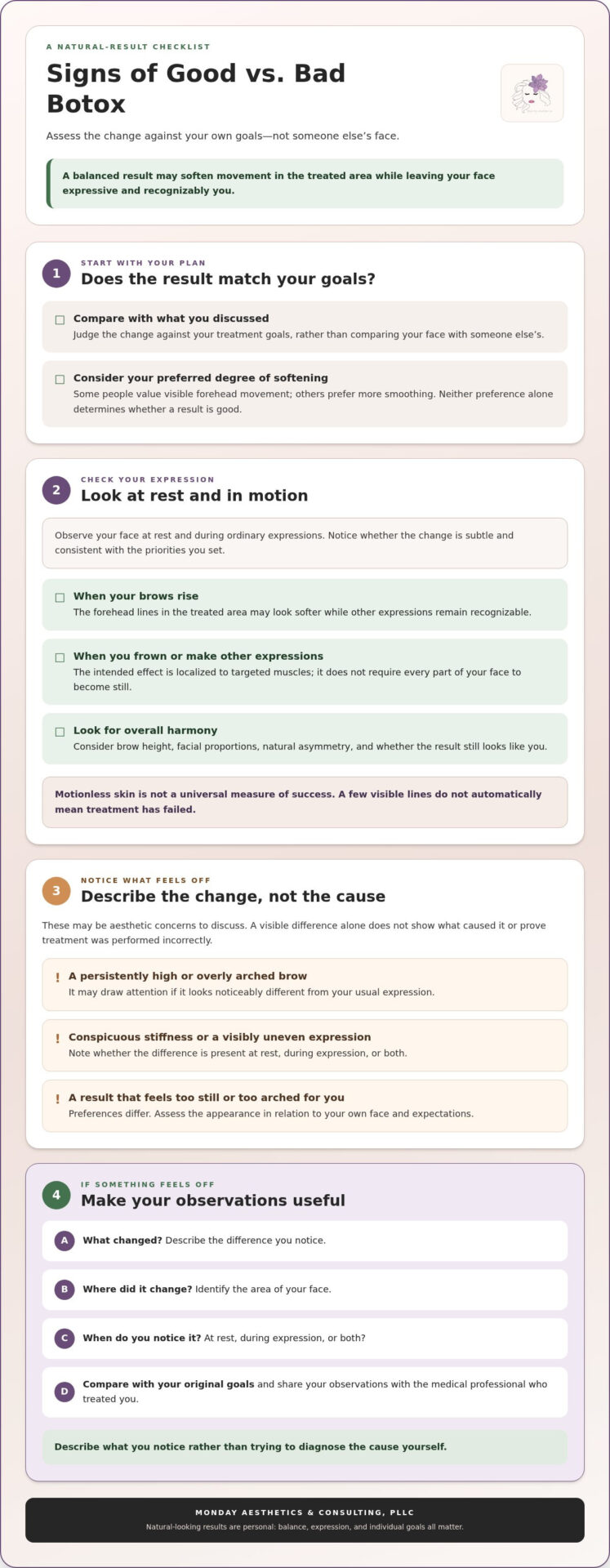
The signs of good vs bad Botox are best assessed against the goals you discussed before treatment, not by comparing your face with someone else’s. A balanced result may soften movement in the treated area while allowing the rest of your face to express emotion comfortably. Often the change is subtle: you still look like yourself, perhaps with a smoother or more rested appearance, rather than a noticeably different expression.
Natural-looking Botox softens targeted lines while preserving facial balance and expression in a way that suits the individual’s features and goals. That leaves room for different preferences. One person may value visible forehead movement; another may prefer more smoothing. Neither preference alone determines whether a result is good. Consider whether the change aligns with your treatment plan and looks harmonious in context.
What are the signs of good Botox?
Look at your face at rest and during ordinary expressions, such as raising your brows or frowning. Lines in the treated area may appear softer when the relevant muscles move, while other expressions remain recognizable. Since Botulinum toxin temporarily affects activity in targeted muscles, the intended effect is localized. It doesn’t require every part of your face to become still.
Balance is personal. Brow height, facial proportions, natural asymmetry, and the goals discussed before treatment all shape what a pleasing result may look like. Motionless skin isn’t a universal measure of success, and a few visible lines don’t automatically mean treatment has failed. Consider whether the change is subtle and consistent with your priorities, rather than judging one feature in isolation.
What can make Botox look unnatural?
Some people find a persistently high or overly arched brow, conspicuous stiffness, or a visibly uneven expression less natural than they intended. A brow that appears unusually surprised, for example, may draw attention because it differs from the person’s usual expression. These are aesthetic concerns to describe, not proof that treatment was performed incorrectly or a diagnosis of what caused the appearance.
Facial appearance is influenced by individual anatomy, patterns of muscle movement, treatment goals, and how the result develops. A visible difference alone can’t establish which factor is responsible. Nor does a result that feels too still or too arched to one person mean the same appearance would be unwanted by everyone. Preferences vary, so assess the change in relation to your own face and expectations.
For a clearer assessment, note what changed, where it changed, and whether it appears at rest, during expression, or both. Compare those observations with the goals discussed before treatment. This gives the treating medical professional useful context without requiring you to diagnose the cause.
Why Botox Results Differ: Facial Muscles, Goals, and Treatment Planning
Botox results vary because faces don’t move in identical ways. Botulinum toxin type A temporarily affects activity in the muscles targeted during treatment; it doesn’t switch off every facial muscle. The visible effect depends partly on how those muscles work together, as well as a person’s natural features, expression habits, and desired degree of softening.
Thoughtful Botox planning accounts for how an individual face moves, not just where lines appear when the face is still. That helps explain why the same approach may look different from one person to another. A simple facial diagram can illustrate the relationship: the frontalis spans the forehead and helps lift the brows, while brow depressor muscles around the brows help draw them downward or inward.
How targeted muscles influence expression
The forehead’s frontalis muscle contributes to raising the brows and creating horizontal forehead lines. Around the eyes and brows, other muscles contribute to actions such as frowning, squinting, and drawing the brows together. These movements interact, so a change in one area can affect the balance someone notices in another. A medical professional considers movement and anatomy together rather than treating a line as an isolated feature.
Brow ptosis means a drooping or lower position of the brow. It can be a physical concern if it affects comfort or vision, and a medical professional can assess it in context. It’s different from simply preferring a lower, softer, or less arched brow shape. A visible change alone doesn’t establish the cause, so describe what you notice rather than trying to identify the underlying muscle or treatment detail yourself.
Why treatment goals matter as much as visible lines
People may have different priorities. One may want forehead lines softened while retaining noticeable brow movement; another may prefer a smoother look in that area. Expression habits matter too. Someone who often raises their brows to communicate may notice a change differently from someone whose forehead moves less during conversation. Existing differences between the two sides of the face can also remain visible or seem more noticeable after a change in movement.
Copying a friend’s result or using a photo as a treatment blueprint can miss important context. A useful discussion covers which expressions matter to you, what you’d like softened, and what you want to preserve. The Mayo Clinic’s overview of Botox injections can help readers understand the procedure and its potential risks, while a qualified medical professional can discuss how your own facial movement informs treatment planning.
If you’re considering Botox in Burlington, talk with Monday Aesthetics & Consulting, PLLC about your priorities. Thea Anderson, a board-certified Nurse Practitioner, provides Botox care at the practice. Individualized planning helps put the signs of good vs bad Botox in context for your features and goals, without assuming every face will respond in the same way.
Expected Effects vs. Warning Signs After Botox: How to Compare Them
After Botox, separate what you notice into three groups: mild effects around the injection site, changes in appearance or expression, and symptoms that may signal a medical problem. A small amount of localized redness, tenderness, or bruising can occur after injections, though experiences vary. The signs of good vs bad Botox don’t replace attention to how you feel overall or medical advice when something concerns you.
Which short-term effects may occur after treatment?
Injection-site effects are usually limited to the treated area. Their presence alone doesn’t tell you whether the aesthetic result is balanced, and their absence doesn’t prove anything about the outcome. Pay attention to severity and progression: mild, localized tenderness differs from symptoms that are worsening, spreading, or affecting how you function. If you’re unsure, contact the medical professional who treated you for guidance.
| What you notice | How to think about it |
|---|---|
| Mild, localized redness, tenderness, or bruising | These may occur around injection sites. Note whether the area stays localized and how it changes. Don’t assume every mark is a complication, or dismiss a symptom that is worsening. |
| Heaviness, an unwanted brow shape, marked asymmetry, or stiffness | These are aesthetic or functional concerns to discuss with the treating medical professional. They don’t, by themselves, reveal why the change happened. Describe what feels different and how it affects your expression or daily comfort. |
| Difficulty breathing, swallowing, or speaking; generalized weakness; or new vision problems | These are not cosmetic imperfections or routine settling. FDA prescribing information warns of serious symptoms related to the spread of toxin effects. Seek urgent medical attention if any of these occur. |
Which symptoms need prompt medical attention?
Take new or worsening symptoms seriously, even if the injection sites look normal. The FDA warning for Botox includes symptoms such as generalized muscle weakness, double or blurred vision, drooping eyelids, difficulty speaking or swallowing, and breathing difficulty. These symptoms may signal effects beyond the treated area. Don’t treat them as an unwanted aesthetic result or simply wait at home.
Safety first: Difficulty breathing, swallowing, or speaking requires urgent medical attention. Seek emergency care rather than waiting for a cosmetic follow-up or trying to manage the symptom yourself.
For appearance concerns without urgent symptoms, keep a simple record of what you notice, when it began, and whether it is changing. A photograph may help you describe a visible difference, but it can’t establish the cause. A qualified medical professional can assess the concern in context and advise you on appropriate next steps.
What to Do If Your Botox Looks Uneven, Heavy, or Too Frozen
An unexpected change can feel unsettling, but you don’t need to decide on your own whether it reflects a treatment issue. Start with clear observations and a conversation with the medical professional who treated you. For non-urgent appearance concerns, a calm, practical approach can help clarify what you’re seeing and what may need assessment.
- Note when you received treatment. Record the date and the areas treated, if you know them. Include when you first noticed the heaviness, asymmetry, or reduced movement, and whether it has changed since then.
- Describe the concern neutrally. For example, note that one brow appears higher, your forehead feels less mobile, or your expression looks different when you raise your brows. Avoid guessing at the cause or labeling the result before it’s assessed.
- Document what you see. Photos taken in similar lighting and from a similar angle can help you explain a visible difference. If useful, capture your face at rest and during ordinary expressions. Images are a record, not a diagnosis, and can’t replace clinical assessment.
- Contact the treating medical professional. Share your observations and ask whether a follow-up assessment is appropriate. Don’t try to correct the change yourself, use unapproved products, press or massage the area to alter the result, or pursue additional treatment without medical guidance.
How to prepare for a useful follow-up conversation
Keep the focus on what you notice and how it affects you. You might say, “My brow feels heavy when I look upward,” or “My expression seems uneven in photos.” Mention when the change began and whether it is stable, improving, or worsening. Bring your notes and photos if you have them, while remembering that a clinician needs to assess your concern in context.
Appearance concerns such as an unwanted brow shape or stiffness differ from symptoms that may require urgent care. The signs of good vs bad Botox can’t be judged from a photo alone, and you shouldn’t have to determine the medical cause yourself. If a symptom is progressing or interfering with normal function, contact a medical professional promptly for advice.
When should you seek urgent care?
Difficulty breathing, swallowing, or speaking requires urgent medical attention. Don’t wait for a routine cosmetic follow-up or treat these symptoms as normal settling. Seek urgent care if they occur. New or worsening symptoms that concern you also warrant prompt clinical guidance, even if they don’t involve your appearance.
If you’re in the Burlington area and have a non-urgent concern about Botox or your treatment goals, contact Monday Aesthetics & Consulting to discuss your concerns. A thoughtful conversation can help clarify what you’re noticing and what next step is appropriate, without promising a particular correction or outcome.
A Thoughtful Botox Consultation in Burlington, WA: Setting Natural-Result Goals
A useful Botox consultation is about more than lines. It’s a chance to explain which expressions you’d like softened, how you want to feel when you see your reflection, and how much movement you’d prefer to keep. A subtle result can mean different things to different people, so your priorities matter more than matching someone else’s face.
At Monday Aesthetics & Consulting in Burlington, Washington, Thea Anderson, a board-certified Nurse Practitioner, provides Botox as part of non-surgical aesthetic care. An individualized assessment helps clarify how Botox aligns with your preferences and circumstances, without assuming a particular treatment or outcome is right for everyone.
Questions that help define a natural-looking result
Before a consultation, consider what you’d like to change and what you want to preserve. You might reflect on questions such as:
- Which lines or expressions draw your attention, and in what situations do you notice them?
- How much movement would you like to retain when you raise your brows, frown, or smile?
- Would you prefer a gentle softening, or is reducing movement in a particular area a higher priority?
- What would make the result feel like you, rather than like a different version of your face?
Reference photos can help communicate the style of result you have in mind, but they’re conversation aids, not templates or promises. Facial structure and movement differ, and a photo can’t predict how another person’s result would translate to you.
How an individualized aesthetic plan supports informed choices
An informed discussion makes room for your goals, natural facial movement, questions, and concerns about possible changes. Rather than following a fixed recipe, a qualified clinician can assess your features and discuss realistic expectations with you. You should feel able to explain what you hope to soften, ask what the treatment may involve, and consider whether its potential benefits and limitations fit your preferences.
You can also discuss other non-surgical aesthetic care if Botox doesn’t seem aligned with your goals. The purpose isn’t to add more treatments, but to understand the choices available and make a considered decision. If you’re comparing the signs of good vs bad Botox, remember that a result can’t be judged apart from your own priorities and facial expression.
You don’t need to arrive with a perfect plan. A calm conversation can help you put your preferences into words and understand what questions remain. If you’re in Burlington and would like Botox care, Monday Aesthetics & Consulting can discuss your goals and what a natural-looking result means to you, without promising a specific outcome.
Take the Next Step With Confidence
Your next step doesn’t have to be an immediate decision about treatment. Start by considering what you hope to change, what you want to preserve, and what would feel authentic. That perspective makes the signs of good vs bad Botox more personal and useful than judging your face against a trend or someone else’s result.
If you still have questions, bring them to a thoughtful consultation. Describe the expressions you’d like softened, share any concerns about movement or balance, and discuss whether Botox fits your goals. There’s room to ask questions, reflect, and make an informed choice at your own pace.
Book a thoughtful Botox consultation at Monday Aesthetics & Consulting, PLLC in Burlington, serving people from Sedro-Woolley, Mount Vernon, Stanwood, Arlington, Marysville, Bellingham, Lynden, Everett, Anacortes, Oak Harbor, and La Conner. Start a conversation about care that respects your individuality.
Frequently Asked Questions
Can Botox look natural?
Yes, Botox can look natural, and the goal is often for others to notice a refreshed expression rather than an obvious change. The signs of good vs bad Botox depend partly on whether the effect suits your facial movement and preferences, not on whether every line disappears. Share your preferred level of movement during a consultation, and use reference photos to explain a look you like, not as a promise of identical results.
How long does it take to see the final Botox result?
Botox effects develop gradually, so the first few days may not show the settled result. It can take about 10 to 14 days for the effect to fully settle, and changes may appear at different rates across treated areas. If you’re assessing a brow or expression difference, note when you received treatment and discuss it with the treating clinician rather than judging the result immediately.
Is bruising after Botox normal?
A small bruise near an injection site can happen after Botox, though not everyone experiences one. Note its size and whether it changes, and contact the treating medical professional if it becomes more painful, spreads, or otherwise concerns you. If you take medication that affects bleeding or bruising, don’t stop or change it on your own; ask a qualified clinician for individual guidance.
Can Botox cause a droopy eyelid or brow?
Yes, a drooping eyelid or brow can occur after Botox, although appearance alone can’t identify the cause. If you notice a new change, contact the medical professional who treated you and describe when it began and whether it affects your vision or daily activities. Seek urgent care for breathing, swallowing, or speaking difficulty rather than treating those symptoms as an aesthetic concern.
What should I do if one side of my face looks different after Botox?
Give the result time to settle, since treated areas may not change at exactly the same pace. Note when you first saw the difference and whether it’s becoming more noticeable; photos in similar lighting can help you describe it. If asymmetry remains concerning after about 10 to 14 days, contact the treating clinician for an assessment. Don’t try to correct it yourself with pressure or additional products.
How long do Botox results usually last?
Botox results commonly last about three to four months, though duration varies by person and treatment area. Track when movement begins returning and discuss that pattern with a clinician instead of assuming a fixed schedule. Monday Aesthetics & Consulting is in Burlington and owned and operated by Thea Anderson, a board-certified Nurse Practitioner. People in Sedro-Woolley, Mount Vernon, Stanwood, Arlington, Marysville, Bellingham, Lynden, Everett, Anacortes, Oak Harbor, and La Conner can visit for a local Botox consultation.