Could an uneven brow or smile in the days after Botox be a sign that something has gone wrong, or is the result still developing? It’s understandable to feel concerned when one side looks different, especially when online advice offers conflicting timelines for touch-ups. Muscles can respond differently, so a mild difference may change as the treatment takes effect. Fixing uneven Botox results calls for patience and a clinician’s assessment, not rushed self-correction.
Botox results typically begin to show in 24 to 48 hours for moderate to severe lines, but the timing and appearance of your individual result can vary. Assessing balance too early may not give a complete picture. This article explains common reasons for temporary unevenness, what to observe, and when to contact the treating practice rather than trying to correct it yourself. You’ll also learn how to describe what you’re noticing at follow-up. At Monday Aesthetics in Burlington, Thea Anderson, NP, takes a thoughtful, less-is-more approach to Botox and individualized care.
Key Takeaways
- A visible difference in brow position, movement, or line softening doesn’t identify its cause on its own. Natural facial asymmetry and how you’re viewing your expression can also affect what you notice.
- Fixing uneven Botox results starts with noting when treatment took place and describing what looks or moves differently, rather than trying to adjust the result yourself.
- Consistent photos at rest and during expression, taken in similar lighting and from the same angle, can help you explain your concern at follow-up.
- Know the difference between an appearance concern to discuss with your treating practice and symptoms that warrant prompt attention.
- Monday Aesthetics in Burlington, led by Thea Anderson, NP, takes a thoughtful, less-is-more approach to Botox and facial balance.
Why Can Botox Results Look Uneven at First?
A visible difference after Botox can be unsettling, but appearance alone doesn’t reveal its cause. “Uneven Botox” generally describes an apparent difference in how the two sides move, where the brows sit, or how much lines soften. It’s an observation, not a diagnosis. Natural facial asymmetry, differing muscle activity, and the way treatment effects develop may all influence what you see.
Botulinum toxin, commonly known as Botox, affects signals between nerves and targeted muscles, temporarily reducing muscle activity. Facial muscles don’t always move identically on both sides, so the visible response may not look perfectly matched. That doesn’t, by itself, establish that the injection placement or dose was incorrect. A clinician can consider your facial movement and treatment details together rather than drawing conclusions from a single image.
How can Botox affect each side differently?
Faces have their own movement patterns. One brow may naturally lift higher, one side may engage more strongly when you frown, or habitual expressions may make a muscle appear more active. After treatment, these differences may become more noticeable as you compare movement or line softening side by side. Uneven-looking movement can have more than one explanation; it isn’t proof of an injection error.
Notice what changes with expression. Your brows, for instance, may look similar at rest but move differently when you raise them or frown. Lighting, camera angle, and the effort you use to make an expression can also affect how symmetry appears. These observations can help you describe your concern, but they can’t confirm which muscle is responding or whether treatment needs adjustment. Avoid trying to diagnose the dose or injection site from a photo.
Why can early results look different from the final appearance?
Botox results can begin to show in 24 to 48 hours for moderate to severe lines, but the timing and visible response may differ between people and muscles. An early change is a snapshot of how your face is responding at that point, not necessarily a complete view of the result. The difference may become less apparent, or it may remain and deserve review. An early appearance can’t predict which will happen for an individual.
“An early difference can show how your face is responding so far, but it can’t explain on its own why the sides look different.”
For a clearer sense of what you’re seeing, compare your face at rest and during the same expression, using similar lighting and angles. Note when the treatment took place and when the difference first caught your attention. This context is more useful than repeatedly checking isolated images or assuming a particular brow position reveals the cause. If you’re concerned, share what you’ve noticed with the treating clinician. Decisions about further assessment or treatment should come from that conversation. A measured approach to fixing uneven Botox results begins with understanding the change, not rushing to correct its appearance.
What Causes Uneven Botox Results as They Develop?
An uneven appearance can have several possible explanations, and more than one may be relevant. The difference may reflect how your face moved before treatment, how each side responds as effects develop, or the conditions in which you’re comparing your features. A mirror or photo can show what seems different, but it can’t establish why.
Visible unevenness is a reason to ask questions, not proof that a treatment mistake occurred. Placement and dose are clinical considerations a qualified clinician evaluates alongside your facial anatomy, expression, treatment history, and the timing of your concern. The Mayo Clinic’s overview of Botox injections also discusses potential side effects such as crooked eyebrows and drooping eyelids, reinforcing why concerns are best assessed in context.
How does natural facial asymmetry affect Botox results?
Brows, eyelids, and expressions may differ subtly even before treatment. One brow might sit higher, or one side of your face may lift more when you smile or frown. If you have pre-treatment photos, compare them with current images showing a similar expression and angle. They can offer useful context, but photos can’t identify the cause or replace a clinical assessment.
Can different muscle strength or treatment response matter?
Yes. If one side is more active, its movement may remain more noticeable as treatment effects develop. Responses can also vary between individuals and across facial muscles. A clinician considers how the muscles move, your treatment plan, and where and how much product was used. You can’t reliably determine these details from appearance alone.
Describe the difference in specific, observable terms rather than labeling it an injection error. For example, note whether one brow rises more when you look surprised, whether one side moves more during a frown, or whether lines appear softer on one side. These details give the treating clinician a clearer starting point for assessment without asking you to interpret the underlying cause.
Perception matters, too. Overhead lighting can cast shadows that make one brow or crease seem more pronounced. A tilted camera, close-up lens, or slightly different expression can also alter the apparent balance. Habitual movement plays a role: you may raise one brow while speaking, squint more on one side, or hold your face differently when concentrating. A single photograph may capture that moment rather than your usual facial movement.
For a more useful comparison, use consistent lighting, camera distance, and angles, and take images both at rest and while making the same expression. If available, pre-treatment photos may help show what was already present. They’re a reference, not a diagnosis. Avoid deciding that one side needs more product based on a mirror check or social media advice. Fixing uneven Botox results begins with a careful review of the pattern and your treatment history, with any decision about changes left to a clinician.
If you’re in Burlington and would like to talk through a Botox concern, Monday Aesthetics’ Botox care is guided by Thea Anderson, NP, with a thoughtful, individualized approach to facial balance.
Is Uneven Botox Normal, or Should You Be Concerned?
A difference in brow height or movement can be unsettling, but it doesn’t automatically mean there’s a complication. Mild appearance changes may shift as Botox effects develop, though there’s no guarantee they’ll resolve on their own. The key is to distinguish an appearance change to discuss with your treating clinician from symptoms that need urgent medical attention.
Use this comparison as a guide, not a diagnosis. If a symptom feels severe or is getting worse quickly, don’t wait for a routine follow-up.
| What you notice | What to do |
|---|---|
| One brow appears higher, forehead movement differs, or one side moves more when you frown. | Make a note of what you see and discuss it with your treating clinician, especially if it persists or concerns you. |
| A facial difference seems to be changing as the treatment develops, without other concerning symptoms. | Keep observing and follow the guidance you received from your treating practice. A change may evolve, but its course can’t be predicted from appearance alone. |
| New or significant vision changes, difficulty swallowing, or difficulty breathing. | Seek emergency care. Don’t wait for a scheduled appointment or rely on online advice. |
| Symptoms that concern you or are worsening, even if they don’t seem immediately severe. | Contact your treating clinician promptly for individualized guidance. |
Which visible changes are worth discussing at follow-up?
Describe the specific difference. Perhaps one brow sits higher, one side of the forehead moves more when you raise your eyebrows, or your frown looks stronger on one side. Note when you first noticed it and whether it seems to be changing. Persistent concern deserves a clinician’s assessment. Searching photos online can’t tell you what’s happening in your individual case or whether a treatment change is appropriate.
The American Society of Plastic Surgeons’ guidance on Botox safety discusses potential complications and the importance of appropriate care. That context can be useful, but it shouldn’t replace personalized advice from the clinician familiar with your treatment.
Which symptoms should not wait for a routine review?
Breathing or swallowing difficulty and significant or new vision changes are not ordinary appearance concerns to monitor while waiting for a cosmetic follow-up. Seek emergency care if these occur. The same applies to severe or rapidly worsening symptoms. For other concerning changes, including symptoms that are getting worse, contact the treating clinician promptly and explain what has changed.
Decisions about fixing uneven Botox results depend on assessment, timing, and the concern itself. A clinician can help distinguish a visible difference to review from a symptom that requires more urgent attention. If you’re unsure which applies, describe your symptoms clearly and seek guidance rather than attempting to self-correct.
What Should You Do If Your Botox Looks Uneven?
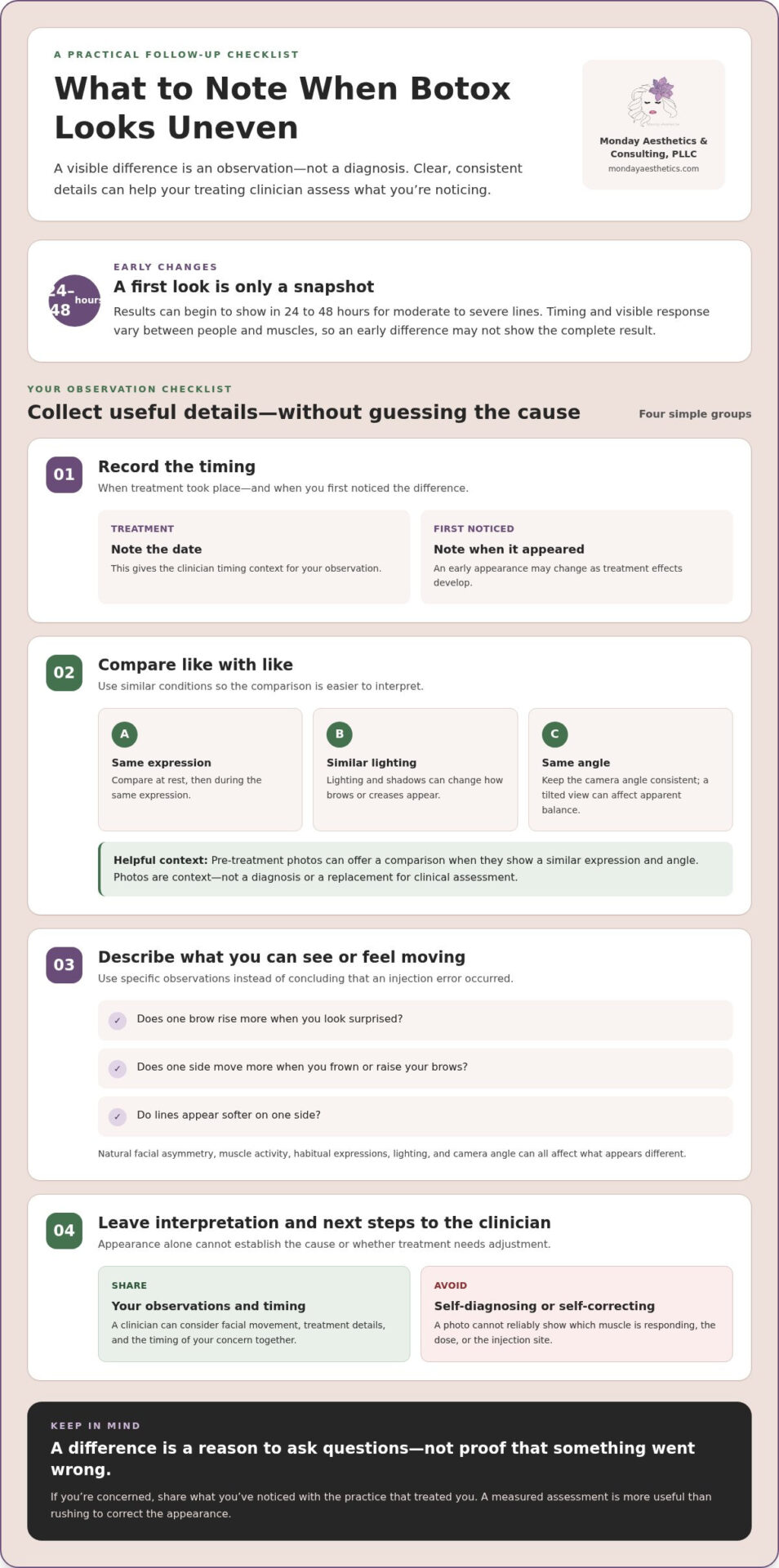
A measured response can make it easier to understand what you’re noticing and explain it clearly. Don’t try to correct the difference yourself. Instead, gather a few useful details and bring them to the clinician who knows your treatment history. The next step depends on your symptoms, timing, and an individualized assessment.
- Note the timing. Write down when you received Botox and when you first noticed the difference. Mention whether it has stayed the same, become more noticeable, or changed over time.
- Document what you see. Describe the specific area and movement that concerns you. If you take photos, use similar lighting, camera distance, and angles. Include an image at rest and others showing the same expression, such as raising your brows or frowning. Avoid comparing pictures taken under very different conditions.
- Contact the treating practice. Share your observations and ask whether a review is appropriate. Include any new symptoms and follow the instructions you receive rather than relying on online timelines or dosing suggestions.
How can you prepare for a Botox follow-up?
Keep your notes simple and factual. For example: “I had treatment on this date, noticed the difference afterward, and my left brow moves more when I raise both.” Bring comparable pre-treatment photos if you have them, along with current images and a list of any symptoms. These details help focus the conversation on your experience without asking you to diagnose the cause.
Online posts can’t account for your facial movement, treatment details, or personal goals. Don’t add injections, massage the treated area to try to change the result, or follow another person’s dose advice. What seemed appropriate for someone else may not fit your situation, and self-directed changes can complicate an assessment.
Why should a clinician decide whether correction is appropriate?
A clinician can review how your face moves, your treatment history, the concern you’ve described, and the result you hope to achieve. Additional treatment isn’t automatically the right response. The appropriate next step depends on what the assessment shows and how the effects are developing. “The right response to unevenness depends on your face, your treatment, and a clinician’s assessment, not a one-size-fits-all correction.”
For concerns that are severe or worsening, or include breathing or swallowing difficulty or significant vision changes, seek emergency care rather than waiting for a routine review. For other concerns, a calm, specific conversation can help your treating clinician understand what has changed and advise you on next steps.
Fixing uneven Botox results is a clinician-led process, not a do-it-yourself adjustment. If you’re in Burlington, contact Monday Aesthetics to discuss your Botox concern with Thea Anderson, NP. A thoughtful review can consider your individual facial balance without assuming that more treatment is the answer.
How Monday Aesthetics Approaches Uneven Botox Concerns in Burlington
Concern about a difference in facial movement deserves a thoughtful conversation, not an automatic assumption that more treatment is needed. Monday Aesthetics is an intimate practice in Burlington, Washington, led by Thea Anderson, NP, with an approach centered on listening, subtle care, and natural-looking results. Patients from Burlington, Sedro-Woolley, Mount Vernon, Stanwood, Arlington, Marysville, Bellingham, Lynden, Everett, Anacortes, Oak Harbor, and La Conner can discuss Botox concerns with the practice. The goal of a follow-up discussion is to understand what you’re noticing and consider appropriate next steps, not to promise a particular correction.
For people seeking help with fixing uneven Botox results, an individualized assessment matters. A brow that moves differently, a change in forehead activity, or a result that doesn’t match your expectations should be considered in the context of your facial movement, treatment history, and personal goals. A calm review can help clarify the concern while keeping decisions about any treatment changes clinician-led.
What can a thoughtful Botox assessment address?
An assessment can begin with your perspective: which area concerns you, when you noticed the difference, and what you hoped your result would look like. Thea Anderson, NP, can consider those details alongside facial movement and relevant treatment history. Comparable photos may help illustrate what you’ve observed, but they’re one part of the conversation, not a substitute for clinical judgment.
Careful listening also makes room for individual goals. Some people value a softening of lines while preserving their natural expression; others may have a particular concern about how one area moves. The appropriate discussion depends on the person, not a standard formula. A touch-up or other treatment change isn’t automatically the answer. The next step should reflect the assessment and your preferences, without assuming that perfect symmetry is necessary or promising a specific outcome.
When should Burlington patients reach out?
If a visible difference persists, feels troubling, or leaves you unsure about how your results are developing, contact the practice to discuss your concern. It can help to share when treatment occurred, what has changed, and whether you’re noticing any new symptoms. You don’t need to arrive with a diagnosis or a proposed correction. Clear observations are enough to begin a useful conversation.
Urgent symptoms are different from routine questions about facial balance. Difficulty breathing or swallowing, significant vision changes, or severe or rapidly worsening symptoms warrant emergency care rather than waiting for a cosmetic consultation. For appearance concerns or questions about your Botox results, an individual conversation can help determine what kind of follow-up is appropriate.
Monday Aesthetics’ less-is-more philosophy supports care that is measured, personal, and attentive to your natural features. If you’re in Burlington and would like to discuss a Botox concern with Thea Anderson, NP, Speak with Monday Aesthetics.
Take the Next Step With Confidence
You don’t need to arrive at a follow-up with a diagnosis or a decision about what should happen next. A clear description of what you notice, what matters to you, and the result that feels authentic can help shape a thoughtful conversation. That perspective keeps fixing uneven Botox results focused on your individual goals rather than an online template or a rushed adjustment.
At Monday Aesthetics, Thea Anderson, NP, leads care with a less-is-more philosophy that values subtle results and your natural features. A consultation is an opportunity to discuss your concerns and consider an appropriate path forward together, without assuming that additional treatment is the answer.
If you’re ready to talk through your Botox concerns, Arrange a thoughtful Botox consultation with Monday Aesthetics. A calm, individualized conversation can be a reassuring first step toward feeling informed and at ease.
Frequently Asked Questions
Is uneven Botox normal during the first few days?
A difference in movement or appearance can be noticeable as Botox effects develop, but response and timing vary. For example, you might notice one side moves differently when making a familiar expression. That observation alone can’t explain why it’s happening or predict whether it will change. Follow the aftercare instructions from your treating clinician, and reach out to the practice if the difference worries you or you’re unsure what you’re seeing.
How long should I wait before asking about uneven Botox?
There isn’t one waiting period that applies to every person or concern. Botox results typically begin to show in 24 to 48 hours for moderate to severe lines, but your treatment plan and symptoms should guide the timing of a review. Ask your treating clinician when they’d like to assess your result rather than relying on a general online schedule. Don’t wait for that review if you develop breathing or swallowing difficulty or significant vision changes; seek emergency care.
Can uneven Botox be fixed with more injections?
Sometimes a clinician may discuss additional treatment, but another injection isn’t automatically appropriate. The decision depends on your facial movement, original treatment, and goals, as well as the clinician’s assessment of possible benefits and limitations. Fixing uneven Botox results isn’t a matter of copying a dose or technique from someone else’s experience. Don’t inject yourself or follow online dosing advice; arrange a clinical review to discuss what, if anything, may be suitable.
What should I do if one eyebrow looks higher after Botox?
Note whether the brow difference is visible at rest, during an expression, or in both situations, and when you first noticed it. A relaxed face and a raised-brow expression may show different patterns. Contact the treating practice to discuss what you’ve observed. Brow position can have several explanations, so a photo or mirror check can’t diagnose the cause. Don’t attempt to change the result without guidance from your treating clinician.
Can natural facial asymmetry make Botox look uneven?
Yes. One eyebrow may naturally sit higher, or one side may move more during an expression, and those differences can influence how treatment appears. If you have pre-treatment images, compare pictures that show a similar expression and facial position. For instance, a neutral photo is most useful alongside another neutral photo, rather than one taken while raising your brows. Images provide context, but a clinician’s assessment is needed to interpret your concern.
When is uneven Botox an emergency?
A difference in facial appearance alone doesn’t determine whether you’re experiencing an emergency. Seek emergency care for difficulty breathing or swallowing, significant vision changes, or symptoms that are severe or rapidly worsening. Don’t wait for a routine appointment if serious symptoms develop. If your concern is limited to appearance and you have no urgent symptoms, contact the treating practice for guidance about an appropriate review.
Should I massage an area that looks uneven after Botox?
No. Don’t massage or manipulate the area to try to change its appearance unless your treating clinician specifically tells you to. Pressure isn’t a reliable way to identify or correct the cause, and self-directed manipulation may conflict with your aftercare instructions. If you’re unsure what care is appropriate, contact the practice that treated you. This guidance applies whether you live in Burlington, Sedro-Woolley, Mount Vernon, Stanwood, Arlington, Marysville, Bellingham, Lynden, Everett, Anacortes, Oak Harbor, or La Conner.