
The threads are temporary, but the changes they prompt can last longer. PDO threads are typically absorbed by the body in about 6-9 months, while collagen stimulation continues for 4-6 months after insertion. Understanding the long term effects of PDO threads means looking beyond when the material dissolves to how your skin responds and whether complications develop.
It’s natural to focus on the lift itself, but it’s just as important to understand what happens as PDO threads break down. Collagen remodeling, how long visible results last, and possible issues such as persistent pain, inflammation, or contour changes all shape the long-term effects of PDO threads.
This article explains how PDO threads dissolve and stimulate collagen, what may affect the timing of repeat treatment, and which lasting complications to recognize. You’ll also learn how an assessment can help put potential benefits and risks in perspective.
Key Takeaways
- PDO threads are typically absorbed in about 6-9 months, while collagen stimulation continues for 4-6 months after insertion.
- Complication estimates vary across studies; substantial heterogeneity means pooled rates are not a prediction of an individual outcome.
- Consider repeat treatment in light of how your lift and skin change over time, rather than assuming a fixed schedule.
- Persistent pain, inflammation, signs of infection, or lasting changes in sensation deserve clinical attention.
- Dimpling, tethering, visible threads, or asymmetry can affect facial contour, so notice changes and discuss them during follow-up.
What Is a PDO Thread Lift?
A thread lift uses absorbable, barbed sutures to reposition tissue and create a tighter appearance in the face or neck. Polydioxanone, or PDO, has been used in wound-closure sutures for 3 decades. The threads provide temporary mechanical support while the surrounding tissue responds to their placement.
Compared with dermal fillers, a PDO thread lift addresses tissue positioning rather than primarily restoring volume. Fillers can add volume, while a surgical facelift involves surgery and addresses facial laxity differently. PDO thread lift results may last one to three years, depending on skin type, age, and lifestyle. These are different treatment approaches, so their duration is not directly comparable.
Discuss any concerns about possible complications with the clinician before treatment. Active infection or inflammation near an insertion site also calls for clinical assessment before a procedure that penetrates the skin.
Complication estimates come from studies with varied methods and follow-up. A facial thread-lift meta-analysis included 2,827 patients and estimated pooled proportions of 0.16 for swelling, 0.26 for bruising, 0.06 for paresthesia, 0.10 for visible or palpable threads, and 0.05 for thread exposure. These estimates describe study groups, not an individual’s outcome.
The figures require context. The studies covered procedures performed between 2002 and 2021, with follow-up ranging from 4 weeks to 30 months. For swelling, heterogeneity was substantial, with an I-squared statistic of 92%. Differences in thread type, placement, patient selection, and reporting can affect pooled estimates, so a single percentage cannot predict every person’s experience.
Long-term complications can include chronic inflammation, persistent pain, infection, foreign-body reaction, wounds, permanent nerve injury, sensory loss, and changes to skin integrity. Scar tissue may also form around a thread or contribute to tethering and contour changes. These outcomes differ from transient bruising or swelling, which are reported separately in complication studies.
Acute complications that may require intervention include infection, vascular compromise, skin necrosis, thread extrusion, direct nerve injury, and loss of skin perfusion. A thread that becomes visible or palpable is another distinct concern. Discuss potential risks and questions with the treating clinician before giving consent, and seek assessment for concerning changes after treatment.
Alternatives depend on the concern: dermal fillers restore volume, while threads reposition tissue. A surgical facelift is a separate option involving surgery. Compare the goal, expected change, and possible complications to determine which approach fits the outcome you want.
How PDO threads dissolve and stimulate collagen
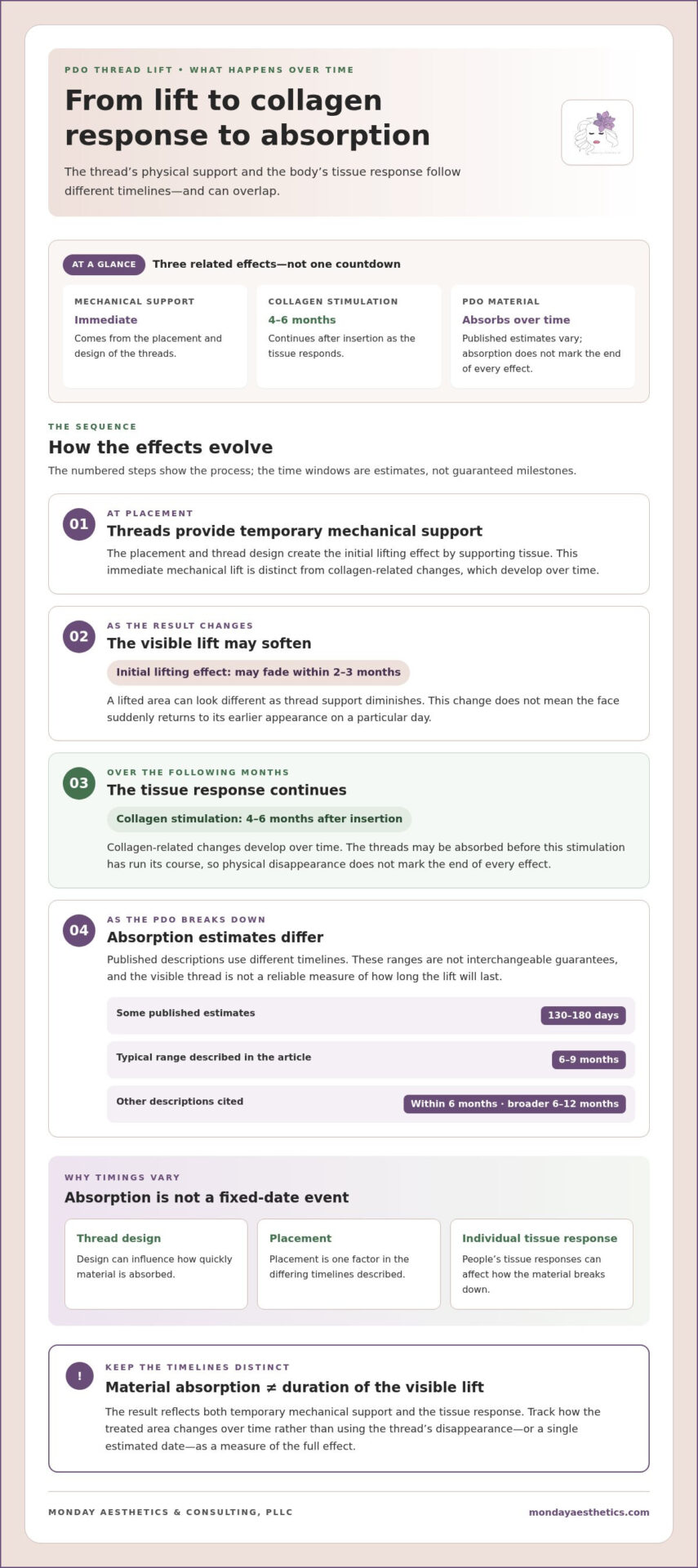
A PDO thread lift has two phases: immediate mechanical support and a gradual tissue response. The threads then dissolve, while collagen stimulation continues after placement.
Thread Dissolution
PDO threads dissolve through the body’s breakdown and absorption of the polydioxanone material. Published estimates vary: some describe absorption in 130-180 days, while others give a typical range of 6-9 months.
These timelines aren’t interchangeable guarantees. Thread design, placement, and individual tissue responses can influence how quickly material is absorbed. Some descriptions say threads used in a lift dissolve within six months after the procedure, while another gives a broader 6-12 months. The differing ranges help explain why the visible thread isn’t a reliable measure of how long the lift will last.
Absorption doesn’t mean the face suddenly returns to its earlier appearance on a particular day. Initial support changes as the material breaks down, and the result reflects both that mechanical effect and the tissue response. For example, a lifted area may look different as support diminishes, even while collagen stimulation continues. This distinction helps set realistic expectations when tracking changes over time.
Collagen Stimulation
Collagen stimulation is the tissue response associated with thread placement, and threads can continue stimulating collagen for 4-6 months after insertion. This process helps explain why changes may continue after the initial lifting effect.
Immediate lifting comes from the placement and design of the threads, which support tissue. Collagen-related changes develop over time, not at the moment of the procedure. The effects overlap, but they aren’t the same: mechanical lifting depends on the threads’ position, while stimulation describes the body’s response around the treated area.
The threads may be absorbed before collagen stimulation has run its course, so their physical disappearance doesn’t mark the end of every effect. Conversely, collagen stimulation doesn’t mean the lift will remain unchanged. Skin characteristics and the treated area shape how the result evolves, so compare changes over time rather than judging only the early appearance.
A surgical facelift works differently and shouldn’t be treated as an equivalent method of collagen stimulation. PDO threads provide temporary support alongside a tissue response that continues for a limited period. Understanding this sequence helps distinguish expected changes from complications such as persistent pain, inflammation, or visible threads, which need clinical assessment.
Recommended interval between repeat treatments
Repeat treatment timing depends on how the lift and facial tissue change over time. The initial lifting effect and the overall duration of results are different measures.
Signs for Considering Repeat Treatment
Consider reassessment when the original lift has softened and your facial goals remain the same. The initial lifting effect may fade within two to three months, while reported results can last one to three years. These describe different effects, not a set appointment schedule. Compare the treated area with your earlier appearance, then consider whether the change still matters to you.
Factors Affecting Treatment Longevity
Skin type, age, and lifestyle influence how long PDO thread-lift results last. These factors help explain why people may notice different timelines after similar treatments. The body’s collagen response and the threads’ mechanical support also change over time. Assess the result in context, rather than using the early lift alone to judge longer-term rejuvenation.
A practical review starts with the treatment goal: facial lifting, tissue support, or another aesthetic concern. Compare your current contour with your desired appearance and note whether the change reflects gradual relaxation or a new irregularity. Discuss repeat treatment when the original concern returns and the tissue has settled, rather than simply because a particular month has arrived.
Repeat treatment can provide renewed mechanical support and another period of collagen stimulation. Its value depends on the benefit you want, the condition of the treated tissue, and whether the previous result suited your features. A minimally invasive approach isn’t automatically the best fit for every concern. For example, loss of facial volume differs from tissue descent and calls for a distinct treatment discussion.
After a PDO thread procedure, follow the aftercare restrictions for a few weeks. Recommendations often include avoiding dental treatments, heavy exercise, and facial massage during that period. These limits matter when considering timing: another session also brings a recovery period. Plan around activities that press on or strain the treated area, and discuss persistent symptoms before considering further treatment.
Reported results can last one to three years, but the initial lift may fade within two to three months. Track changes over time instead of treating either period as a repeat-treatment deadline. This distinction helps separate a softer early lift from the overall result and supports a considered decision about facial rejuvenation.
Chronic inflammation, pain, and infection
Thread-lift recovery discussions often focus on early discomfort, but persistent symptoms deserve separate attention. Long-term complications associated with PDO threads include chronic inflammation, ongoing pain, infection, foreign-body reaction, and wounds. These differ from temporary tenderness because they continue or emerge beyond the expected recovery period. Recognizing that distinction helps you describe changes clearly during a clinical consultation.
A facial thread-lift meta-analysis estimated pooled proportions of 0.11 for postoperative pain and 0.02 for infection. Those figures summarize reported study groups, not an individual patient’s likelihood. The studies also showed substantial variation: postoperative pain had an I-squared statistic of 86%. Differences in study methods and patient groups make the pooled pain estimate less suited to predicting one person’s experience.
Pain can persist after a thread lift, and chronic inflammation or a foreign-body reaction may occur around implanted material. In some cases, the body’s response may also involve a wound or ongoing discomfort. Persistent symptoms shouldn’t be treated as evidence that collagen stimulation is working. Collagen production is a treatment response; continued pain or inflammation is a separate concern that calls for assessment.
Infection is another possible complication, distinct from the expected short-term effects of a minimally invasive procedure. The pooled infection proportion was 0.02, but this does not rule out infection in an individual case. Worsening pain, persistent inflammation, or a wound after thread placement warrants prompt clinical assessment. Avoid scheduling another thread procedure to enhance a lift while those concerns remain unresolved.
When arranging a consultation, describe when the pain or inflammation began, where it occurs, and whether it is changing. Mention any known reaction to implanted material and whether a thread appears exposed. These details help the clinician assess possible infection, foreign-body reaction, or another complication. Share prior thread treatments too, as they may affect how the treated tissue is evaluated.
A surgical facelift and PDO threads involve different procedures, so persistent symptoms after threads shouldn’t prompt a treatment switch without assessment. Dermal fillers address volume, not thread-related inflammation or infection. If you have ongoing pain, a wound, or an inflammatory response, focus the consultation on that complication first. Discuss aesthetic alternatives after the affected tissue has been evaluated.
Contour irregularities and asymmetry
After a thread lift, uneven contours can appear as dimpling, asymmetry, or skin and soft-tissue tethering. These changes may reflect how polydioxanone sutures support tissue beneath the skin. A facial thread-lift meta-analysis estimated a pooled proportion of 0.07 for skin dimpling or asymmetry. That estimate describes study groups, not an individual outcome.
Contour changes can look different. A small indentation may appear only when smiling, while tethering can make skin seem fixed during movement. One side may also look higher than the other, creating visible asymmetry. Scarring alopecia, or hair loss associated with scarring, is another reported long-term complication of thread lifts. Not every irregularity has the same cause or calls for the same response.
Both placement and tissue response matter. Threads are intended to support tissue, but tension, position, and individual healing can affect the surface contour. Collagen production is part of the tissue response, yet it doesn’t explain every irregularity. For example, a persistent dimple may relate to tethering rather than simply reflect collagen changes. A practitioner needs to assess the location and movement of the affected area.
Note when an uneven area appears and whether it changes with facial expression. Describe its location, such as a cheek indentation or one side of the jawline. Photos taken in consistent lighting can help show changes over time. Avoid pressing, massaging, or trying to reposition a thread yourself, since this can disturb healing tissue.
An assessment can distinguish a contour concern from complications such as an exposed thread, wound, or ongoing inflammation. Tell the practitioner whether the irregularity is stable, worsening, or visible only during movement. Describe any discomfort or skin changes as well. These details help guide the evaluation and clarify whether the issue relates to thread position, tissue tethering, or another response.
Treatment options depend on the cause. Dermal fillers can restore volume, but they don’t reposition a tethered thread or treat a wound. Match a minimally invasive approach to the specific concern rather than using it to conceal an unexplained change. For persistent asymmetry, discuss the contour and its likely cause before considering additional aesthetic treatment.
If facial volume loss is part of the concern, explore dermal filler treatment as a distinct option. A focused discussion can help distinguish volume changes from thread-related contour irregularities, so the next step addresses the concern itself.
Monday Aesthetics & Consulting, PLLC: Botox
Monday Aesthetics & Consulting, PLLC offers Botox as one option within a broader approach to aesthetic care. If you’re weighing further treatment after learning about PDO threads, a discussion can help distinguish your main concern, such as facial movement, volume, or skin texture, and consider an appropriate next step.
Monday Aesthetics also offers dermal fillers, microneedling with HA serum, and laser hair removal, each for a different aesthetic goal. These treatments don’t replace assessment of persistent pain, inflammation, infection, or a thread-related contour change. Bring your questions and describe the outcome you’re seeking so the conversation can focus on your priorities.
For a thoughtful discussion of aesthetic options, contact Monday Aesthetics & Consulting, PLLC in Burlington, Washington, or visit mondayaesthetics.com.
Choose a Next Step That Fits Your Goals
Decisions about the long-term effects of PDO threads are best approached with attention to your priorities, not pressure to pursue another procedure. Consider what you hope to change, what concerns you about previous treatment, and whether ongoing symptoms need assessment before planning further aesthetic care.
Monday Aesthetics & Consulting, PLLC offers Botox, Dermal Fillers, and Microneedling with HA Serum for distinct aesthetic goals. A conversation can help you discuss which concern matters most and whether one of these options fits your aims. If you’re ready to explore that next step, contact Monday Aesthetics & Consulting, PLLC.
Move forward at a pace that feels considered and true to you.
Frequently Asked Questions
Are PDO Threads Dangerous?
PDO threads carry risks, but “dangerous” doesn’t describe every treatment or outcome. A facial thread-lift meta-analysis estimated a pooled infection proportion of 0.02, while acute complications can include vascular compromise, skin necrosis, nerve injury, and allergic reaction. These are different from temporary bruising or swelling. Before treatment, discuss your medical history, concerns, and the possibility of intervention if a complication occurs.
How Long Do PDO Threads Last?
The threads are temporary, and absorption timelines vary across descriptions. Estimates range from 130-180 days to about 6-9 months; Monday Aesthetics’ treatment information describes PDO threads dissolving over 6-8 months. The thread’s presence and the visible aesthetic result aren’t identical measures. For example, a change in contour can continue after the material has started breaking down, so don’t use the thread’s absorption alone to judge the result.
What are the long-term effects of PDO thread lifts?
Possible lasting effects include changes in facial contour, sensation, or skin integrity, as well as ongoing inflammation, pain, infection, or wounds. The long term effects of PDO threads aren’t limited to visible lifting: a person may also notice tethering during facial movement or an area that feels different to touch. Note when a change began and whether it affects expression, comfort, or daily activities.
How long do PDO thread lift results last?
Results may last one to three years, depending on skin type, age, and lifestyle. This differs from how long the threads remain in the body. For a practical comparison, consider the original goal, such as supporting a cheek or jawline, and whether that change remains meaningful as your face naturally changes. A fading lift doesn’t by itself indicate a complication or mean another treatment is due.
Do PDO threads stimulate collagen after the threads dissolve?
Yes. Collagen stimulation can continue after the PDO material is absorbed; threads have been reported to stimulate collagen for 4-6 months after insertion. The tissue response and physical thread are separate parts of the process. For instance, the material may no longer be present while changes associated with collagen remodeling are still developing. That response doesn’t mean the mechanical lift will remain unchanged.
What are the long-term risks and complications of PDO threads?
Reported long-term complications include chronic inflammation, persistent pain, infection, foreign-body reaction, wounds, permanent nerve injury, sensory loss, and changes to skin integrity. A thread may also become visible or palpable. If a treated area develops a wound, ongoing pain, or altered sensation, describe the timing and location during clinical assessment. This information helps distinguish a persistent complication from a change in appearance alone.
Can PDO threads cause scarring, dimpling, or permanent changes?
Yes. Reported complications include scarring alopecia, dimpling, tethering, asymmetry, and skin changes; permanent nerve injury or sensory loss can also occur. An indentation that appears during a facial expression differs from a wound or a change in sensation. Note whether an irregularity is present at rest, appears with movement, or is changing. Don’t try to manipulate a thread yourself, as this can disturb the treated tissue.
How often can PDO thread lifts be repeated safely?
There’s no single repeat schedule that fits everyone. The initial lift may fade within two to three months, while overall results can last one to three years; skin type, age, lifestyle, and the treated area shape the timeline. Consider reassessment based on the change you want, not a calendar date. After treatment, recommendations often restrict dental work, heavy exercise, and facial massage for a few weeks.