
A natural-looking filler plan often begins with restraint, not another syringe. To understand how to avoid looking overfilled, focus on facial balance, skin quality, and how your features move. Add volume conservatively and reassess before considering more. Treating every fold or hollow can soften familiar expressions and make the face look heavier rather than refreshed.
It’s understandable to want smoother contours while still looking like yourself. Facial folds and expression lines are part of how your face moves, and eliminating every line isn’t always the most natural goal. The amount of filler alone doesn’t tell the whole story: placement and how each area relates to the rest of the face matter, too.
This article explains what an overfilled appearance can look like and why the cheeks, lips, and areas around the mouth need careful consideration. You’ll also learn how gradual treatment can help preserve facial movement, how filler differs from treatments that address muscle activity or skin quality, and what to discuss with your injector before choosing a plan.
Key Takeaways
- Learn to notice changes in facial proportion, contour, and movement that may suggest filler is becoming too prominent.
- Understand why repeated top-ups can contribute to an overfilled look, even when each treatment seems modest.
- Bring clear goals, past treatment details, and reference photos to help your injector plan around your natural features.
- Recognize when concerns involve skin laxity or tissue descent, where adding volume may not address the underlying issue.
- Explore how a considered treatment plan, including Botox when appropriate, can address facial goals without relying on filler alone.
How facial volume and expression affect appearance
Facial rejuvenation involves more than filling a visible line. Volume, anatomy, skin quality, and movement all shape how balanced a face appears.
Individualized facial balancing
Individualized facial balancing assesses features together rather than treating each hollow or fold on its own. It considers facial proportions, structure, movement, skin quality, and overall harmony. This matters because the same volume can look subtle on one face and prominent on another. For example, restoring midface support may soften nasolabial folds without placing filler directly into them.
Natural faces have folds and expression lines. Trying to erase every line can make the face look less expressive. A thoughtful plan identifies which feature affects balance most, then considers whether volume, muscle activity, or skin quality is the relevant concern. This keeps rejuvenation focused on your features, not an isolated mark.
Filler placement and facial anatomy
Filler placement means selecting a product, depth, and location to suit your facial anatomy. Even small amounts require anatomical knowledge and precision. Poor placement or repeated additions can create excess fullness, even with adjustable hyaluronic acid filler. Two syringes placed in the wrong area may look overdone, while the total amount alone cannot predict the result.
Facial tissue moves and supports neighboring areas, so placement affects more than the injection point. Using small amounts across several areas can be preferable to concentrating a larger amount in one spot. Repeating a small cheek dose two or three times can also alter facial shape. The goal is proportion, not a particular syringe count.
Expression is part of facial balance, too. Injectable treatments may add volume or affect targeted muscle activity, depending on the treatment. A plan should preserve the movement that makes your smile, brow, or speech feel recognizably yours. Discuss which expressions you want to retain and identify specific changes you hope to see. These details help distinguish a desired adjustment from a request to remove every natural crease.
A qualified clinician should assess your anatomy and treatment goals before injecting. Ask how the proposed placement relates to nearby features and what change it is intended to create. A facial specialist should explain why an area needs support rather than simply treating every visible fold. If excess skin or advanced tissue descent drives your concern, filler cannot lift facial structures or tighten loose skin. More volume may make the tissue heavier instead.
How long should you wait between filler appointments? There is no fixed interval that suits every plan. Hyaluronic acid filler settles and integrates over 2-4 weeks, so reassess after swelling resolves before considering more.
What are the risks of dissolving dermal filler? Hyaluronidase can dissolve hyaluronic acid filler, but it has limitations and potential adverse effects. Its suitability depends on the filler type and treatment area, so dissolving requires clinical assessment.
What Is an “Overfilled” Face?
An overfilled appearance occurs when added volume disrupts facial proportions instead of supporting them. Signs that dermal filler has been overdone can include persistent puffiness, blurred contours, or features that look unusually prominent together.
Signs of overdone filler
An overfilled face may appear rounded or heavy, with less definition around the cheeks, jaw, or mouth. Lips can look disproportionate to the chin and other features. In some cases, fullness changes how expressions read, making facial movement seem less natural. These signs describe appearance, not a diagnosis. Swelling soon after treatment can temporarily affect the result.
Some swelling is normal for 24-48 hours after an injection. A useful distinction is whether fullness changes as early swelling settles, or remains and affects facial proportions. Compare the treated area with older photographs taken at rest and while smiling. Look for changes in contour across the whole face, rather than judging one feature in a close-up selfie.
Common causes of an overfilled appearance
Common causes include adding volume without reviewing previous treatments, repeatedly treating the same area, and choosing placement that doesn’t suit facial structure. Hyaluronic acid filler can be adjusted, yet poor placement or repeated additions may still create excess fullness. Skin quality and tissue support also influence how filler looks over time.
Repeated top-ups can make the total amount easy to underestimate. Top-ups every six months over several years may leave considerably more filler than a person realizes. Filler can also remain in the face longer than expected, particularly in some areas. Adding new product before reviewing earlier treatment can therefore compound fullness rather than restore definition.
Another cause is treating each line as a separate problem. For example, filling folds around the mouth without considering surrounding volume can make the lower face look heavier. A plan focused only on smoothing may overlook skin quality, tissue descent, or facial proportions. Filler adds volume, but it doesn’t lift facial structures or tighten loose skin.
To understand a change, note where filler was placed, when it was injected, and how the appearance has evolved. Bring that treatment history and comparison photos to a clinical assessment. If your goal involves restoring contour, discuss whether dermal filler treatment addresses the cause, rather than simply adding volume where a line appears.
What Should You Tell Your Injector to Get a Natural Result?
A natural-looking plan begins with clear goals and an assessment of your facial anatomy. Describe the change you want, the features you want to preserve, and any previous injectable treatments.
Choosing an injector with a natural aesthetic
An injector with a natural aesthetic prioritizes proportion, expression, and individual features over dramatic change. This approach matters because “refreshed” can mean different things to different patients. The American Society of Plastic Surgeons says 2025 aesthetic trends emphasize subtle, natural results over dramatic transformations.
Look for an injector who explains each treatment’s purpose in relation to your face. Ask what improvement they expect, which features they would leave unchanged, and why. For example, if your goal is to look less tired, describe that feeling rather than requesting a specific amount of filler. The discussion should connect your goal with an appropriate technique.
Anatomy-focused provider selection
An anatomy-focused injector plans around facial structure, movement, skin quality, and proportions. That assessment matters because the same placement can affect faces differently. Ask how the proposed location supports nearby features and how it may look while you smile or speak. A qualified clinician uses anatomical knowledge to guide product selection, depth, and placement.
Discuss your treatment history, including product type and location when known. Tell your injector about changes you’ve noticed since earlier treatments, such as persistent fullness or altered contours. This context helps the assessment account for existing filler instead of treating each appointment as a blank slate.
Before treatment, make your preferences specific. You might say, “I want a softer transition beside my mouth, but I want my smile to remain expressive.” You can also name features you don’t want emphasized, such as a wider-looking cheek or a more prominent upper lip. These examples give your injector a clearer aesthetic direction.
- Share your priority: describe the feature or expression you hope to address.
- Name what matters: identify the facial qualities you want to preserve.
- Discuss past treatments: share dates, areas, and products, if you know them.
- Ask about the endpoint: find out what visible change would signal that treatment is complete.
The appropriate clinical endpoint, not the amount of opened filler, should determine when treatment stops. A conservative plan can leave room for reassessment instead of addressing every concern in one visit. Ask whether treatment can be staged, allowing swelling to settle before considering additional product.
Bring your desired change, treatment history, and boundaries to a dermal filler consultation. A useful plan explains how the technique relates to your anatomy, what it will address, and what it won’t change. That clarity helps you make an informed decision while keeping your natural expression central.
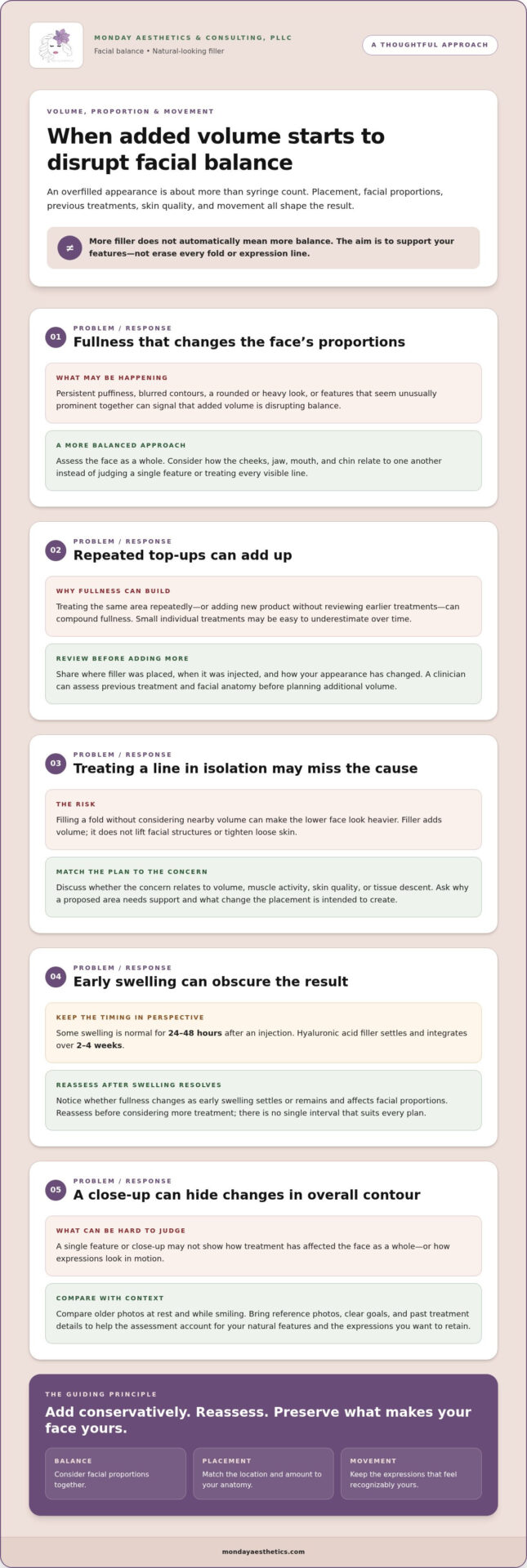
Warning signs of overfilling
An overfilled result can change facial proportions, not just one feature. Look for persistent fullness, softened contours, or expressions that seem different from your usual movement. Compare your face at rest and while smiling. Those two views can reveal changes that a close-up photograph may exaggerate.
Early swelling can make an area look fuller than its settled result. Some swelling is normal for 24-48 hours after an injection. Hyaluronic acid filler may take 2-4 weeks to settle and integrate. Reassess after swelling resolves, rather than treating a fresh post-injection appearance as the final outcome.
Look for patterns across the face, including:
- Persistent puffiness: cheeks or under-eye areas appear full after initial swelling has eased.
- Blurred contours: the cheek-to-jaw transition looks less defined than before treatment.
- Changed proportions: lips, cheeks, or chin draw attention away from neighboring features.
- Altered movement: smiling or speaking makes fullness more noticeable or changes your familiar expression.
These observations can guide a consultation, but they don’t identify the cause by themselves. Compare current photos with earlier images taken in similar lighting and from similar angles. Note when each treatment occurred, which areas were treated, and whether fullness changed over time. Filler may remain in the face longer than expected, particularly in some areas, so older injections can still matter during assessment.
Timing helps clarify what to do next. If fullness appears immediately after treatment, allow the normal swelling period to pass before judging the result. If a contour change persists after the settling period, arrange a consultation to review your treatment history and facial movement. Avoid adding product just to balance a feature before understanding why it looks different.
During the assessment, the clinician can consider placement, existing filler, skin quality, and tissue support together. Hyaluronic acid filler may be reduced or reshaped with hyaluronidase, but dissolving has limitations and potential adverse effects. The filler type and treatment area affect whether this approach is suitable. Gradual correction may be appropriate when excess has accumulated.
More volume isn’t always the answer. Dermal fillers add volume, but they can’t lift facial structures or tighten loose skin. If advanced tissue descent or excess skin drives your concern, a surgical consultation may be preferable to trying to restore contour with more filler. The distinction matters: treating laxity with more volume can make tissue heavier without addressing its cause.
Areas at risk of looking overfilled
Some facial areas show excess volume more readily because their contours shape nearby features. The cheeks, lips, under-eye area, folds beside the nose, and jawline all need assessment within the context of the whole face. A conservative plan considers how adding filler in one area changes balance elsewhere, rather than treating each hollow separately.
Cheeks: Cheek filler can support the midface, but repeated additions may widen or round the face. Compare the cheek’s contour with the temples, lower face, and natural bone structure. Restoring midface support may soften nasolabial folds without placing filler directly into them. The key question is whether support improves overall proportions, not simply whether a cheek looks fuller.
Under the eyes: The under-eye area sits beside the cheek, and its appearance changes with lighting and facial movement. Adding volume there without considering cheek support can create an uneven transition. During assessment, compare both areas in natural light and at rest. A visible hollow may relate to surrounding structure, skin quality, or volume, so its location alone doesn’t determine the approach.
Lips and the area around the mouth: Lip filler can look prominent when its volume doesn’t suit the chin, nose, or existing lip shape. Look at your profile as well as the front view. Folds beside the mouth also need context: filling each crease directly can add fullness to the lower face. A balanced plan considers nearby support before choosing a target.
Jawline and chin: These areas define the lower facial outline, so adding volume can change your face’s shape. A fuller jawline may appear heavier if the cheeks or chin aren’t considered together. Facial anatomy, tissue support, and the desired contour all matter. For example, a sharper outline may not suit a face with naturally softer proportions.
Across these areas, dermal filler should follow facial structure rather than a fixed template. Small amounts across multiple areas can be an alternative to concentrating a larger amount in one spot. A staged plan also allows swelling to settle before considering more product. Hyaluronic acid filler can still look excessive when placement is poor or product is repeatedly added.
For a practical consultation, identify the feature that concerns you most, then ask how it relates to neighboring areas. Bring photos showing your face at rest and smiling. If you’re considering a dermal filler assessment, discuss your desired contour and areas you want to preserve. The central takeaway: evaluate the whole face before adding volume to one area.
Monday Aesthetics & Consulting, PLLC: Botox
Monday Aesthetics & Consulting, PLLC offers Botox and dermal fillers for different aesthetic goals. Botox affects targeted muscle activity, while fillers add volume. Understanding the difference can help you describe whether you’re concerned about expression lines, facial volume, or both.
Consider an assessment if you’re weighing treatments, have concerns about existing filler, or want a plan that respects your natural facial movement. Bring your treatment history and explain which features you want to preserve. A thoughtful discussion can help clarify whether Botox, dermal fillers, or another approach best fits your concerns.
For a measured conversation about your goals, contact Monday Aesthetics & Consulting, PLLC or visit mondayaesthetics.com.
Let Your Next Step Reflect Your Own Features
A useful next step is to define what “refreshed” means to you before choosing a treatment. Consider which expressions you want to keep, what feels out of balance, and what change would still feel like you. This personal reference can make a future conversation more focused, especially if your goals involve several concerns rather than one visible line.
A thoughtful approach to how to avoid looking overfilled starts with matching the treatment to the concern, not following a trend or fixed template. Monday Aesthetics & Consulting, PLLC offers Botox, Dermal Fillers, and Microneedling with HA Serum. These options address different aesthetic goals, so the conversation can center on what you hope to change and what you want to preserve.
When you’re ready to explore a plan that respects your natural expression, contact Monday Aesthetics & Consulting, PLLC. A clear goal and an open conversation are a considered place to begin.
Frequently Asked Questions
Why Do Some People Look Overfilled?
Some people look overfilled because filler accumulates, sits in a prominent area, or doesn’t suit their facial proportions. Previous injections may remain after someone assumes they have faded, so new volume can add to existing product. Repeated cheek or lip treatments, for example, can gradually change the face’s outline. Anatomy, skin quality, product choice, and treatment history all influence how fullness appears.
Can overfilled filler be fixed?
Overfilled hyaluronic acid filler can often be reduced with hyaluronidase, an enzyme that breaks down this type of filler. It doesn’t work for every filler and has limitations and potential adverse effects. A clinician assesses the product and area before choosing this option. Correction may be gradual and may require more than one session. Ultrasound can also help identify filler and guide treatment when appropriate.
How can I avoid looking overfilled?
To learn how to avoid looking overfilled, bring your treatment history and clear goals to a consultation. Explain which facial features you want to preserve, not only what you hope to change. Ask the injector to describe the intended endpoint and why the proposed placement suits your features. A treatment record with dates, areas, and products can also help prevent decisions based on incomplete memory.
Can too much filler make you look older?
Yes, excess filler can make the face look heavier or less defined, creating an older appearance rather than a refreshed one. Added fullness, for example, can soften the cheek-to-jaw transition or make lower-face contours seem less distinct. Filler adds volume, but it doesn’t tighten loose skin or lift descended tissue. Matching treatment to the cause of the concern matters.
Do You Need to Use the Entire Syringe?
No. The amount used should be guided by the appropriate clinical endpoint, not by how much product remains in a syringe. If the planned subtle change is achieved before the syringe is empty, treatment can stop. Tell your injector that you prefer a measured result and are comfortable reassessing later. Product handling after treatment follows clinical protocols, not a need to use every drop.
How Can Overfilling Be Prevented?
Prevention starts with reviewing prior treatments before planning additional filler. Keep a simple record of product names, injection areas, and dates, then bring it to your appointment. Discuss whether your concern relates to volume, skin quality, or tissue laxity, since each calls for a different approach. For readers in Burlington, WA, a local consultation can provide space to discuss these goals before choosing a treatment.
How Much Is Too Much?
There isn’t one amount that defines too much for every face. The deciding factors include facial anatomy, product type, placement, existing filler, and whether the result preserves natural proportions. A modest amount can look excessive in a sensitive area, while another plan may distribute volume more evenly. The meaningful measure is whether the change supports the intended appearance without creating unwanted fullness.
What does looking overfilled after cosmetic filler mean?
Looking overfilled means added volume makes facial features appear unusually full, less defined, or out of proportion with one another. It describes an appearance, not a specific diagnosis. Lips may seem overly prominent beside the chin, for instance, or cheek fullness may blur the face’s natural contour. Early swelling can temporarily affect appearance, so timing and changes as the area settles are relevant.