
Could an IPL photofacial be a considered way to address visible discoloration or redness while preserving the character of your skin? If you’re researching IPL photofacial Burlington care, you may be wondering what the treatment can address, whether it suits your skin, and what to expect during and after a visit.
The first step is understanding both IPL’s potential and its limits. Results aren’t guaranteed, and candidacy depends on individual skin characteristics, goals, and health considerations. At Monday Aesthetics in Burlington, board-certified Nurse Practitioner and practice owner Thea Anderson takes an individualized approach to aesthetic care, starting with your concerns and realistic options.
This guide covers the skin concerns IPL may address, how candidacy is assessed, and what treatment, comfort, recovery, and possible side effects can involve. It also outlines useful questions to bring to a consultation, so you can make an informed decision at your own pace.
Key Takeaways
- Learn how filtered pulses of light work and how IPL differs from laser treatment.
- Understand which visible skin concerns IPL may address and why outcomes depend on individual assessment.
- Discover how skin characteristics, medical history, medications, sun exposure, and treatment goals inform candidacy.
- See how consultation, skin assessment, treatment planning, and tailored aftercare shape an IPL photofacial Burlington experience.
- Explore IPL care at Monday Aesthetics in Burlington, guided by practice owner and board-certified Nurse Practitioner Thea Anderson.
What Is an IPL Photofacial, and What Can It Address?
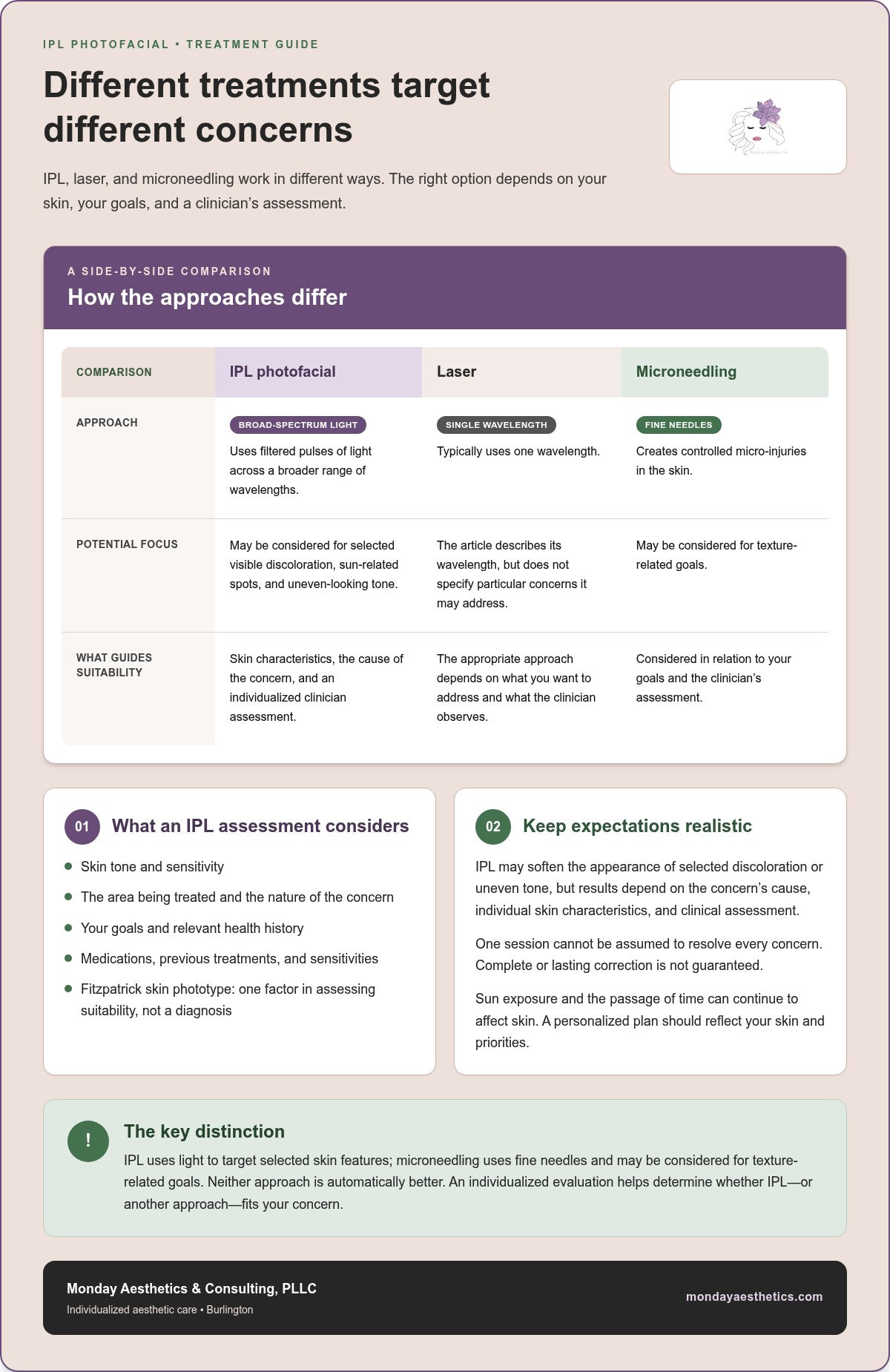
An IPL photofacial uses filtered pulses of light to target selected features in the skin. Unlike a laser, which typically uses a single wavelength, intense pulsed light (IPL) delivers a broader range of wavelengths. The light interacts with targets such as pigment, which is why IPL may be considered for some visible discoloration and uneven tone. Whether it is appropriate depends on an individual assessment, not a standard promise.
Featured snippet definition: An IPL photofacial is a light-based treatment that uses filtered pulses of broad-spectrum light to target selected skin features, including some forms of visible discoloration. It differs from a laser, which typically uses one wavelength.
How Does Intense Pulsed Light Work on the Skin?
Different structures in the skin absorb light in different ways. During IPL, selected light energy is directed toward particular targets and may be absorbed and converted to heat. This interaction provides a basis for assessing whether treatment may fit someone’s skin goals. It does not guarantee a particular cosmetic change.
Photodamage refers to changes in the skin associated with sun exposure over time, including areas of uneven pigmentation. Melanin is the natural pigment that gives skin, hair, and eyes much of their color. The Intense Pulsed Light (IPL) Technology overview offers additional background on how broad-spectrum IPL differs from single-wavelength laser treatments.
What Skin Concerns Might Lead Someone to Explore IPL?
You might bring visible discoloration, sun-related spots, or uneven-looking tone to an IPL consultation. Because these concerns can have different causes, an assessment helps determine whether IPL may be suitable or another approach may better match your skin and goals.
Redness may also be worth discussing, but its cause and pattern matter. A dedicated guide to IPL for redness can explore that concern in more detail. IPL isn’t a universal treatment for every skin issue, and it may not address concerns related to texture, deeper skin changes, or other causes. For an IPL photofacial Burlington treatment, a clinician’s evaluation helps clarify what the light may reasonably target and where expectations should remain measured.
What Results Can an IPL Photofacial Realistically Offer?
An IPL treatment plan should start with what you hope to change, not a promise of flawless or permanent correction. Some people explore IPL to soften the appearance of selected discoloration or uneven tone. The potential change depends on the concern’s cause, individual skin characteristics, and the clinician’s assessment.
One session can’t be assumed to resolve every concern, and no treatment can guarantee complete or lasting correction. Skin continues to respond to factors such as sun exposure and the passage of time. During a consultation, you and the clinician can define a realistic goal, discuss treatment limits, and decide whether IPL is appropriate before proceeding. A thoughtful IPL photofacial Burlington plan reflects your skin and priorities rather than a standard result.
Which Factors Can Influence an IPL Treatment Plan?
An assessment may consider skin tone and sensitivity, the area being treated, the nature of the visible concern, and your goals. A clinician may also consider Fitzpatrick skin phototype, a classification based on how skin tends to respond to sun exposure. This is one part of assessing suitability, not a diagnosis or a substitute for examining your skin.
These details matter because light-based treatment needs to be considered for each person. The clinician determines whether IPL is suitable and how treatment settings should be selected. Don’t rely on an online description or a skin-type label alone to decide. An individualized assessment provides a more responsible basis for planning.
How Is IPL Different from Other Skin Treatments?
IPL and microneedling use different approaches, so one isn’t automatically better than the other. IPL uses light energy to target selected skin features. Microneedling uses fine needles to create controlled micro-injuries in the skin and may be considered for texture-related goals. If texture is your main concern, learn more about microneedling with HA serum in Burlington.
The suitable option depends on what you want to address and what the clinician observes. In a personal consultation, Thea Anderson, board-certified Nurse Practitioner and owner of Monday Aesthetics, can discuss your goals and whether IPL fits your plan. You can explore an IPL consultation in Burlington as a considered next step.
Who May Be a Candidate for an IPL Photofacial in Burlington?
There isn’t one profile that determines whether IPL is suitable. The decision depends on your skin, the concern you want to address, relevant health information, and the clinician’s assessment. Skin can respond differently to light-based treatment, so no single setting or expected result fits everyone.
At Monday Aesthetics in Burlington, an IPL candidacy conversation helps clarify whether treatment aligns with your goals. The practice serves Burlington and surrounding communities, so patients can discuss their options close to home. The clinician assesses suitability rather than relying on a self-assessment or a general description of who IPL is “for.”
What Is Discussed During an IPL Candidacy Assessment?
A personal consultation gives you the opportunity to describe what you notice about your skin and what you hope to address. The clinician can consider your skin characteristics alongside relevant health history, medications, previous treatments, and the area you’re considering. Share sensitivities and concerns, even if they seem unrelated, so the clinician has useful context for the assessment.
Recent tanning or sun exposure may also be relevant to treatment planning. The clinician evaluates its significance, as well as the relevance of medications or past procedures, for your situation. Share this information openly rather than stopping a medication or changing your routine on your own.
When Might a Clinician Recommend a Different Approach?
The concern you want to address may not be well matched to IPL, or an individual factor may affect whether treatment is appropriate at that time. Based on the assessment, a clinician may recommend another option, further discussion, or different timing. That guidance is part of matching the approach to your needs and keeping expectations grounded.
It also helps to be clear about your goal. IPL may be considered for selected visible pigment concerns, while a desire for added hydration is different. For that goal, explore SkinVive hydration benefits as a separate treatment discussion. The right choice depends on what you want to address, not simply on choosing a popular procedure.
If you’re considering an IPL photofacial Burlington consultation, bring your questions and relevant skin or treatment history. Thea Anderson, practice owner and board-certified Nurse Practitioner, can assess your goals and help determine whether IPL is suitable for you.
What Happens Before, During, and After an IPL Photofacial?
An IPL visit starts with a conversation and assessment. Before treatment is considered, the clinician reviews your goals, relevant health history, medications, skin characteristics, and recent sun exposure. This helps establish whether IPL may be appropriate and what guidance applies to your situation.
If treatment is suitable, the clinician explains the proposed approach, possible sensations during the procedure, and what to expect afterward. These details vary, so another person’s experience shouldn’t be treated as a forecast for yours. Ask questions and make sure you understand the plan before proceeding.
How Should Someone Prepare for an IPL Consultation?
A little preparation can make the discussion more useful. Consider bringing:
- Your main treatment goals and questions about what IPL may address
- A current list of medications and relevant health history
- Details about previous skin treatments and recent tanning or sun exposure
There isn’t one pre-treatment routine that suits everyone. Follow the clinician’s individualized guidance about sun exposure and skin care, and share any changes in your health or medication before treatment. If something is unclear, ask for clarification rather than changing your routine on your own.
What Can Patients Expect After Treatment?
Aftercare instructions depend on the treatment plan and the clinician’s assessment. Before leaving, make sure you understand how to care for your skin, whether activities or products may need to be adjusted, and whom to contact with a concern. The treating clinician can explain expected skin responses and recovery for your circumstances.
Follow those instructions rather than applying a generic online routine. If something feels unexpected or causes concern, contact the practice for guidance. Following your plan helps the clinician respond to your individual needs.
For an IPL photofacial Burlington visit, useful preparation means having an open conversation and understanding the plan. Schedule an IPL consultation at Monday Aesthetics to discuss your goals and receive guidance tailored to your skin.
Explore IPL Photofacial Care at Monday Aesthetics in Burlington
Understanding what IPL may address is a useful start. Deciding whether it belongs in your care plan calls for a conversation about your skin and priorities. Monday Aesthetics offers IPL in Burlington, Washington, with an individualized approach that puts suitability and realistic expectations at the center of the discussion. The practice serves people in Burlington and nearby communities, including Mount Vernon and Sedro-Woolley.
The practice is owned by Thea Anderson, a board-certified Nurse Practitioner. She can discuss what you hope to address, assess whether IPL may be appropriate, and explain what the treatment can and cannot reasonably offer. A consultation is an opportunity to ask questions and consider your options, not a commitment to proceed.
How Does an Individualized IPL Consultation Support Better Decisions?
A goals-focused discussion connects a treatment choice to the concern that matters to you. You might be interested in the appearance of uneven tone, while another person may have a different concern or expectation. Those distinctions guide the assessment and help clarify whether IPL aligns with your priorities.
Candidacy and planning are considered before any treatment decision. Your skin characteristics, relevant health information, and goals all contribute to that discussion. If IPL isn’t the right fit for your concern or circumstances, the conversation can help clarify why and what other considerations may be relevant. The aim is a considered choice, not an assumption that everyone needs the same approach.
How Can Burlington-Area Patients Take the Next Step?
If you’re considering an IPL photofacial Burlington treatment, review the service and note the questions you want answered. You may want to discuss your goals, skin history, how suitability is assessed, and how treatment expectations are set. Bringing those questions can help make your consultation focused and useful.
Monday Aesthetics is based in Burlington and serves surrounding communities, including Sedro-Woolley, Mount Vernon, Stanwood, Arlington, Marysville, Bellingham, Lynden, Everett, Anacortes, Oak Harbor, and La Conner. Explore IPL photofacial care and begin a thoughtful conversation about your skin goals.
Take a Thoughtful Next Step for Your Skin
An IPL photofacial may be worth exploring for selected concerns, such as visible discoloration or uneven tone, but it isn’t a universal solution. Your skin characteristics, health history, and goals help inform whether treatment is suitable. A personal assessment can clarify realistic expectations, the proposed approach, and the preparation and aftercare guidance for your situation.
Monday Aesthetics offers IPL in Burlington, Washington, for people considering an IPL photofacial Burlington treatment. The practice is owned and operated by Thea Anderson, a board-certified Nurse Practitioner, who can discuss your skin goals and whether IPL may be appropriate. There’s no need to rush the decision. Informed care begins with a conversation.
Explore IPL photofacial care at Monday Aesthetics and take a considered first step toward a plan that feels right for you.
Frequently Asked Questions
What is an IPL photofacial, and how does it work?
An IPL photofacial uses filtered pulses of broad-spectrum light to interact with selected targets in the skin. The light may be absorbed by areas of pigment, which is why IPL can be discussed for concerns such as visible discoloration. It isn’t a guaranteed correction: how the skin responds depends on individual characteristics and clinical assessment. A clinician can explain whether this light-based approach fits your goals.
Is an IPL photofacial suitable for every skin tone?
No. Suitability can vary with skin tone, sensitivity, the concern being treated, and other individual factors. A clinician may consider your skin characteristics and history before deciding whether IPL is appropriate and how treatment should be planned. Don’t use a general online description or a skin-type label to determine candidacy on your own. A personal assessment is the more reliable way to discuss potential benefits and limitations.
Can IPL help with sun spots or uneven skin tone?
IPL may be considered for some visible discoloration, including spots associated with sun exposure, or an uneven-looking tone. Whether it may help depends on the cause and appearance of the concern, as well as your skin and treatment goals. An assessment can clarify what IPL may reasonably target and whether another approach would be more suitable. Results vary, so treatment shouldn’t be viewed as a promise of complete or permanent correction.
How many IPL photofacial treatments might someone need?
There isn’t one treatment count that applies to everyone. The plan depends on the concern, the area being considered, your skin characteristics, and the clinician’s assessment of your response and goals. A consultation can clarify whether more than one treatment may be considered, but a specific number shouldn’t be assumed before that discussion. Ask what factors would guide your plan and how progress would be evaluated.
What should I expect after an IPL photofacial?
Aftercare and recovery guidance are tailored to the treatment plan and your clinician’s assessment. Before treatment, discuss what skin responses may occur, how to care for your skin afterward, and whether you should adjust products or activities. Follow the instructions provided for your situation rather than relying on a generic routine. If you experience an unexpected reaction or have a concern, contact the practice for guidance.
Is IPL the same as laser treatment?
No. IPL uses filtered pulses of broad-spectrum light, while a laser typically uses a single wavelength. Both are light-based approaches, but they aren’t interchangeable. The right option depends on the skin concern and individual assessment. During a consultation, a clinician can explain whether IPL is relevant to your goals and discuss its limitations. The distinction alone doesn’t determine which treatment is preferable for a particular person. To see how specialized laser therapies are utilized for discoloration and skin brightening, you can discover Be-Youth and review their clinical approaches.
Where can I explore an IPL photofacial in Burlington, WA?
Monday Aesthetics & Consulting, PLLC offers IPL in Burlington, Washington. The practice is owned and operated by Thea Anderson, a board-certified Nurse Practitioner, and serves patients in the surrounding area, including Sedro-Woolley, Mount Vernon, Stanwood, Arlington, Marysville, Bellingham, Lynden, Everett, Anacortes, Oak Harbor, and La Conner. To discuss your goals and suitability, explore IPL photofacial care at Monday Aesthetics.