
What if the wisest choice about Botox in your twenties is not to start early, but to understand what your skin is showing you? If social media has made preventative Botox feel like a milestone, it’s reasonable to wonder whether it’s worthwhile, whether it could change your natural expression, and what ongoing treatment might involve. For anyone considering preventative Botox for 20s Stanwood WA, the answer depends less on age and more on your facial movement, your concerns, and the result you want.
Botox can temporarily soften expression lines caused by repeated muscle movement, but it can’t stop aging or guarantee that lines won’t develop. Lines that appear when you smile or frown differ from those that remain visible at rest. That distinction is a useful starting point when considering whether treatment makes sense now, later, or not at all.
In this guide, you’ll learn what preventative Botox can and can’t do, how candidacy is considered, and how to prepare for a careful consultation. Monday Aesthetics & Consulting, PLLC, is based in Burlington and serves Stanwood. The practice is owned and operated by board-certified Nurse Practitioner Thea Anderson, with an individualized approach focused on helping you make an informed decision without pressure.
Key Takeaways
- Age alone doesn’t determine whether Botox is appropriate. Facial movement, your concerns, health history, and goals matter more.
- Botox may soften selected expression lines temporarily, but results and duration vary from person to person.
- Weigh the potential benefits, risks, and possibility of repeat appointments before deciding whether preventative Botox for 20s Stanwood WA is right for you.
- Prepare for a useful conversation by noting what you want to address and sharing relevant health information. You can take time to decide.
- Stanwood residents can explore Botox with Monday Aesthetics & Consulting, PLLC in Burlington, led by board-certified Nurse Practitioner Thea Anderson.
What Does Preventative Botox in Your 20s Actually Mean?
“Preventative Botox” is an informal term for using Botox to temporarily soften selected expression lines before they become more persistent. It doesn’t mean preventing wrinkles altogether. Botox reduces activity in specific muscles, which may soften the creases those muscles create. It doesn’t stop the natural aging process or address every factor that affects skin.
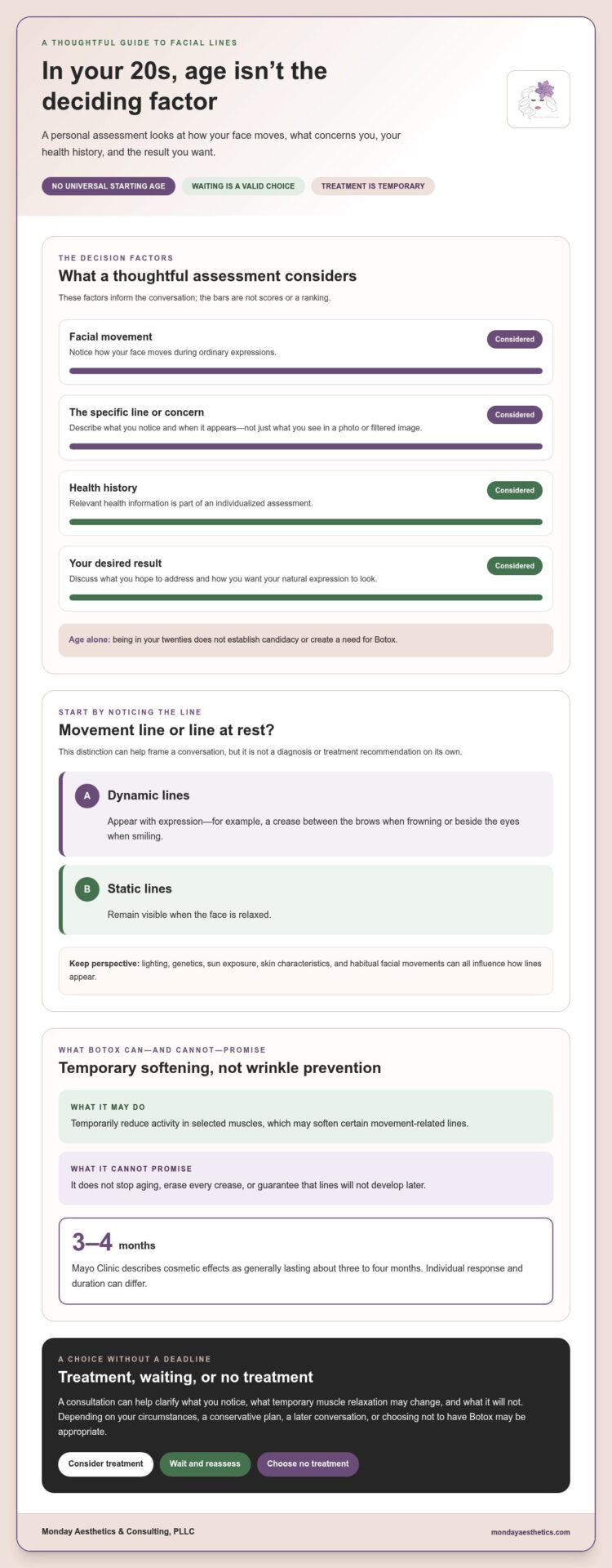
The phrase can make treatment sound like a deadline, but it isn’t one. Being in your twenties, by itself, doesn’t establish candidacy or create a medical or aesthetic need for Botox. A thoughtful assessment considers how your face moves, whether a line concerns you, your health history, and what kind of result you want. Depending on those factors, waiting or choosing not to have treatment may be the most appropriate decision.
Dynamic lines, lines at rest, and normal facial movement
Dynamic lines appear with expression. A crease may show between the brows when you frown or beside the eyes when you smile. Over time, repeated movement can contribute to lines becoming more noticeable. Static lines, by contrast, remain visible when the face is relaxed. This distinction can help frame a conversation, but it isn’t a diagnosis or a treatment recommendation on its own.
Skin and expressions vary from person to person. Genetics, sun exposure, skin characteristics, and habitual facial movements all influence how lines appear. A line seen in a photograph or under bright lighting may look different in person and at rest. Notice how your face looks through ordinary expressions rather than comparing it with a filtered image. That gives you a more grounded way to describe what you’re seeing.
Why people in their twenties consider early treatment
Some young adults become curious when they notice a line during repeated expressions or see treatment discussed by peers online. Social media can make early intervention seem routine, necessary, or time-sensitive. That framing overlooks individual differences and the fact that choosing no treatment is also a valid outcome. There’s no universal age when someone needs to begin.
Botox is a form of botulinum toxin treatment. For a general overview of botulinum toxin and its uses, readers can consult this reference. An aesthetic decision, however, should be grounded in a personal clinical assessment rather than an online trend. A consultation can help you describe what you notice, understand what temporary muscle relaxation may and may not change, and consider waiting, skincare measures, or treatment without pressure to proceed.
For readers researching preventative Botox for 20s Stanwood WA, a useful first question isn’t “Am I old enough?” but “What am I hoping to address, and is treatment appropriate for that concern?” The answer may point toward a conservative plan, a later conversation, or no Botox at all. The aim is an informed choice that respects natural expression, not treatment simply because a birthday or social feed suggests it’s time.
How Botox Works, and What the Evidence Can and Cannot Promise
Botox temporarily reduces activity in selected muscles. When a treated muscle contracts less strongly, the skin above it may fold less during expressions such as frowning or raising the eyebrows. This can soften certain movement-related lines, but it doesn’t pause the aging process, erase every crease, or ensure that wrinkles won’t develop later.
The effect is temporary. Mayo Clinic describes cosmetic effects as generally lasting about three to four months, though an individual’s response and duration can differ. Ongoing treatment is therefore a personal decision, not a one-time guarantee of future skin smoothness. Mayo Clinic’s overview of Botox injections explains the treatment and its uses in more detail.
What a neuromodulator changes during facial expression
Facial muscles create the movement that contributes to expression lines. A neuromodulator acts on communication between nerves and selected muscles, temporarily reducing contraction in the treated area. For example, less movement in a muscle between the brows may soften a crease that forms when someone frowns. An individualized plan aims to address a specific concern while respecting natural expression.
Botox doesn’t replace skincare, sun protection, or the ordinary movement that gives a face character. It also doesn’t directly address every cause of visible lines, such as skin texture or sun-related changes. The appropriate treatment area and expected effect depend on personal anatomy and assessment, not a standard approach or an assumed result.
What research does, and does not, establish about prevention
Evidence statement, reviewed October 2026: FDA-approved Botox Cosmetic labeling covers temporary improvement of specified facial lines in adults, including forehead lines, crow’s feet, and frown lines between the eyebrows. It does not establish a separate indication for preventing future wrinkles. Mayo Clinic describes Botox as temporarily reducing muscle activity and notes that cosmetic effects wear off. These sources support treatment of certain existing lines, not a promise of lifelong wrinkle prevention or a medical requirement to begin treatment in your twenties.
It’s plausible that reducing repeated folding in a treated area may influence how a line appears while muscle activity is reduced. But that possibility shouldn’t be confused with proof that early treatment prevents all future wrinkles. Long-term outcomes depend on many factors. The fact that treatment can improve visible lines doesn’t, by itself, demonstrate what will happen over decades for someone who starts young.
For someone considering preventative Botox for 20s Stanwood WA, the useful question is what a specific concern may respond to and what limits come with temporary treatment. A balanced discussion can cover expected changes, uncertainty, and the option to wait. A Burlington Botox consultation with Monday Aesthetics & Consulting can help you consider a personalized approach without treating early intervention as a requirement.
Is Preventative Botox Worth It in Your 20s? Weigh the Trade-Offs
Early intervention isn’t automatically better than waiting. Botox may be worth discussing if a particular expression line consistently concerns you. Treatment also means accepting temporary effects, possible side effects, and the prospect of repeat appointments to maintain a similar result. Weigh those considerations against your priorities, not a trend or a birthday.
Use the questions below as a starting point, not a scorecard. A consultation can help clarify whether your concern relates to muscle movement, skin texture, or something else, and whether Botox is likely to address it. Exploring treatment doesn’t commit you to receiving it.
| Consideration | Potential value | Limitation and question to reflect on |
|---|---|---|
| Repeated expression lines | Reducing activity in selected muscles may soften a line that forms during a familiar expression. | Would this specific line still bother you if you waited, and does it show mainly with movement? |
| Temporary results | A time-limited effect lets you assess how a change feels to you. | Results fade, and maintaining them may involve recurring appointments. Are you comfortable with that ongoing commitment? |
| Possible side effects | A clinician can explain the risks in the context of your health and treatment area. | Temporary tenderness, bruising, headache, or an unwanted change in muscle movement can occur. What level of uncertainty feels acceptable to you? |
| Skin-quality concerns | Skincare, sun protection, or another approach may better match concerns about dryness or texture. | Botox targets muscle activity, not every skin concern. What change are you actually hoping to see? |
Reasons someone might explore a consultation
You might seek guidance if a line repeatedly appears with a specific expression and you want to understand what could realistically soften it. Bring a clear example, such as a crease that forms when you concentrate, rather than asking for a treatment simply because it’s popular. The conversation can distinguish movement-related lines from texture or other skin-quality concerns, then consider whether an option fits your goals.
Reasons waiting may be the right choice
Waiting can make sense if you value full facial movement, don’t want recurring maintenance, or feel unsure about treatment. Minimal concern is reason enough to defer. Daily sun protection and a consistent skincare routine are practical, non-injectable parts of caring for skin. If your main goal is hydration or skin quality rather than movement-related lines, Monday Aesthetics & Consulting, PLLC’s SkinVive hydration guide explains a different approach.
For readers weighing preventative Botox for 20s Stanwood WA, a useful decision may be to gather personalized information first, then take time to consider it. The right choice may be treatment, a later reassessment, or no treatment. There’s no need to turn curiosity into a commitment.
How to Prepare for a Botox Conversation Without Feeling Rushed
A useful consultation begins with your goals, not a predetermined treatment. Before discussing Botox, identify what you notice and what you want to understand. You might say, “I see a line between my brows when I concentrate,” or “I want to keep my expressions natural.” Describing your concern in your own words gives the clinician a clearer starting point than asking for a look you saw online.
Keep the conversation grounded with a simple sequence: name your concern, share relevant health information, discuss possible approaches and trade-offs, then take time to decide. You can ask questions, request clarification, or choose not to proceed. Exploring treatment is not a commitment to receive it.
Questions to bring to an individualized assessment
Save a few questions in your phone or bring them on paper. Clear answers can help you understand whether a proposed plan fits your concern and preferences.
- What specific concern would this treatment address, and is it related to muscle movement?
- What alternatives could I consider, including waiting or focusing on skincare?
- What changes might I reasonably expect, and what won’t treatment address?
- What risks should I understand, and how is follow-up handled if I have a concern?
- How would the plan preserve natural expression and reflect my preferences?
These questions invite a discussion about benefits and limitations rather than a promise of a particular result. If an answer feels unclear, ask for an explanation in plain language. You deserve to understand the proposed approach before making a decision.
What to share before discussing treatment
Give the clinician a relevant picture of your health. Share your medical history, current medications and supplements, allergies, and previous aesthetic treatments, including how you responded. Don’t stop or adjust medication on your own to prepare for a cosmetic treatment. If you’re unsure whether something matters, mention it and let the clinician guide the discussion.
The clinician should review your history, assess the area and facial movement, and explain potential benefits and risks. That assessment helps determine whether Botox is appropriate for you as an individual. Your age or interest in treatment alone can’t answer that question. Your concerns and comfort level should inform the conversation, and it’s reasonable to take time before deciding.
Consultation checklist: State your concern in your own words; share relevant health details; ask what treatment can and cannot change; discuss risks, alternatives, and follow-up; and decide at your own pace.
If you’re considering preventative Botox for 20s Stanwood WA, bring your questions to Monday Aesthetics & Consulting in Burlington. The practice serves Stanwood and nearby communities. To discuss your goals with practice owner and board-certified Nurse Practitioner Thea Anderson, schedule a Botox consultation.
Considering Preventative Botox Near Stanwood? A Personal Consultation Comes First
Deciding whether to explore Botox is personal. Monday Aesthetics & Consulting is based in Burlington and serves patients from Stanwood and nearby communities, including Sedro-Woolley, Mount Vernon, Arlington, Marysville, Bellingham, Lynden, Everett, Anacortes, Oak Harbor, and La Conner. The practice is owned and operated by Thea Anderson, a board-certified Nurse Practitioner. Its approach centers on thoughtful assessment and care that respects each person’s natural features.
A consultation isn’t a commitment to treatment. It’s an opportunity to talk through what you’ve noticed, understand what Botox may address, and consider whether it fits your goals. For some people, that conversation may support a conservative treatment plan. For others, another approach or simply waiting may feel more appropriate. Both can be considered without treating age as an indication.
What an individualized approach should clarify
A useful assessment connects your concern with how your face moves, your relevant medical history, and the outcome you hope for. For example, you might want to understand whether a line appears mainly during expression or remains visible when your face is relaxed. The discussion should also set realistic expectations, including what treatment is intended to change and what it cannot address. A thoughtful plan reflects your features and preferences, not a standard age or dose.
Before making a decision, consider whether the proposed approach aligns with what you’ve shared. You should have space to ask questions and understand the reasoning. A personalized conversation may lead to Botox, another option for your concern, or a decision to revisit the subject later. The next step should feel considered, not assumed.
A considered next step for readers in Stanwood
If you’re exploring preventative Botox for 20s Stanwood WA, write down what prompted your interest and what you hope to preserve, such as comfortable facial movement or a natural-looking result. Bring any questions that would help you feel informed. You can also take time to reflect before booking. Curiosity alone doesn’t mean you need treatment.
Monday Aesthetics offers a local consultation option in Burlington for patients traveling from Stanwood and nearby communities. The focus is on understanding the individual, not following a trend or promising a particular result. An open conversation can help clarify whether Botox is relevant to your concern while leaving the decision in your hands.
When you feel ready to explore your options, explore Monday Aesthetics and begin with a conversation, not an assumption.
Let Your Next Step Reflect Your Own Goals
You don’t need to decide on treatment before you’re ready. A useful next step can be as simple as noticing what you’d like to understand better: a line that appears with a particular expression, how treatment might affect movement, or whether a non-injectable approach better fits your priorities. Clear questions can make a conversation more useful without making a procedure feel inevitable.
If you’re considering preventative Botox for 20s Stanwood WA, let your decision begin with your comfort and preferences, not pressure to act early. The right timing is personal, and choosing to wait is valid. If you want to talk through your goals, Monday Aesthetics & Consulting offers an individualized approach centered on preserving natural expression.
Explore a thoughtful, individualized aesthetic consultation and take the next step at your own pace. Whatever you decide, you can move forward with a clearer understanding of your options.
Frequently Asked Questions
Is preventative Botox in your 20s safe?
Botox may be appropriate for some adults after an individualized medical assessment, but no cosmetic injection is risk-free. The FDA approves Botox Cosmetic for certain facial lines in adults; “preventative” use is not a separate FDA-approved indication. A clinician should review your health history, medications, allergies, goals, and possible side effects before recommending treatment. For readers near Stanwood, Monday Aesthetics & Consulting is based in Burlington.
Can Botox prevent wrinkles from forming?
Botox can temporarily reduce muscle activity, which may lessen repeated folding in a treated area while the effect lasts. It can’t guarantee that wrinkles won’t form, prevent every type of line, or stop skin from changing with age, sun exposure, and other influences. Consider it a treatment for specific muscle-related lines, not a shield against future wrinkles or a replacement for sun protection and skincare.
What age should you start preventative Botox?
There’s no universal age to begin, and being in your twenties doesn’t by itself make Botox necessary. The relevant question is whether treatment is appropriate for a particular concern and your health. If you’re researching preventative Botox for 20s Stanwood WA, focus on your goals and how your face moves rather than a trend-based deadline. If you don’t have a concern you want addressed, waiting is a reasonable choice.
How long does Botox last when you start in your 20s?
Cosmetic effects commonly last around three to four months, but timing varies between individuals and treatments. Starting in your twenties doesn’t establish a longer or shorter duration. If you’re considering ongoing treatment, think about whether you’re comfortable with results gradually wearing off and the possibility of repeat appointments. Your clinician can discuss what to expect for your situation and help you decide whether follow-up fits your preferences.
Does preventative Botox make your face look frozen?
Botox doesn’t automatically make a face look frozen, but reduced movement or an unwanted change in expression is possible. The outcome depends on factors such as the treatment plan, facial anatomy, and individual response, so no approach can promise a particular look. Before deciding, describe the expressions you want to preserve, such as raising your brows or smiling naturally. Your preferences should be part of the assessment and plan.
What happens if you stop getting Botox after starting in your 20s?
If you stop, the temporary effect wears off and muscle activity gradually returns. The treated area generally moves toward its untreated appearance rather than becoming dependent on injections. Your skin continues to change over time, so it may not look exactly as it did when you began. Stopping doesn’t require a special tapering schedule, though you can discuss any concerns or changes with your clinician.
Is Botox in your 20s worth it if you only see lines when smiling?
Not necessarily. Lines that appear only with a smile can be part of normal expression, and their presence alone doesn’t mean they need treatment. Consider whether they genuinely bother you, whether they remain noticeable when your face is relaxed, and whether you’re comfortable reducing movement in that area. A clinician can assess your concern and discuss options, including leaving the lines untreated if that best reflects your wishes.