Good Botox aftercare is less about following a long list of prohibitions and more about a few sensible precautions. If you’re wondering what to avoid after Botox treatment, conflicting advice online can make an ordinary walk, facial expression, or bedtime feel consequential. It’s reasonable to want to protect your results, but not every commonly repeated restriction has the same level of support.
Recommendations can differ. The American Academy of Dermatology advises avoiding rubbing or massaging treated areas and waiting two hours before strenuous activity, while some injectors use more conservative timelines. This guide separates practical precautions from rules that need nuance, explains why your injector’s protocol matters, and outlines symptoms that warrant prompt medical attention. Your treatment details and medical history may also shape individualized guidance. You’ll come away with a calmer framework for aftercare and a clearer sense of when to contact the clinician who knows your treatment.
Key Takeaways
- For what to avoid after Botox treatment, focus on sensible precautions and follow the timing your injector recommends.
- Exercise and heat guidance can vary. Distinguish conservative clinic instructions from universal rules before changing your routine.
- Approach sleeping, facial expressions, makeup, and alcohol without treating every common tip as a strict requirement.
- Use a simple aftercare checklist to review your instructions, avoid unnecessary pressure on treated areas, and monitor how you feel.
- Recognize when a concern calls for prompt medical assessment, and seek individualized guidance from the clinician who treated you.
What to Avoid After Botox Treatment in the First Hours
After Botox, most patients need a few practical precautions, not an elaborate recovery routine. In the first hours, leave the injection sites alone unless your injector has given you different instructions. Avoid rubbing, pressing, or massaging treated areas, and follow your clinician’s guidance about when to resume particular activities. You don’t need to monitor every expression or movement.
It’s understandable to want to protect your treatment, especially when online advice makes small actions sound consequential. General aftercare is a helpful starting point, but it can’t account for every treatment plan or personal circumstance. The reason for treatment, areas treated, injection technique, and relevant medical history may all shape your instructions. If anything you were told is unclear, contact the treating clinician rather than adding restrictions based on a general online list.
Why rubbing or pressing injection sites is commonly discouraged
Injectors may advise against unnecessary pressure or massage near injection points to avoid irritating the skin and manipulating the treated area. This means deliberate contact, such as firmly rubbing your forehead, pressing on a site, or using a facial massage tool. It doesn’t mean you need to hold your face rigid: ordinary expressions are different from intentionally massaging or manipulating the skin.
If you brush a site by accident, try not to panic or repeatedly touch it to check. A single brief touch doesn’t automatically mean your result will change. For background on the substance and its broader uses and potential side effects, see Botulinum toxin on Wikipedia. Your injector’s directions are the more relevant guide to your own aftercare.
Which instructions take priority after treatment?
Use the written and verbal directions from the clinician who performed your injections as your primary reference. General advice can explain common precautions, but the treating injector knows which areas were treated and can tailor recommendations to your technique and circumstances. If you receive Botox in Burlington, Washington, the same principle applies: your location doesn’t create a different set of aftercare rules, while your individual treatment plan may affect the advice you receive.
For a calm first-hours routine, keep these points in mind:
- Leave treated areas alone. Avoid deliberate rubbing, massage, or firm pressure.
- Follow your injector’s instructions about timing and any activity restrictions.
- If you’re unsure whether an action counts as pressure or manipulation, ask the clinician who treated you.
In brief: Avoid unnecessary contact with injection sites, keep normal facial movement natural, and let your injector’s specific directions guide your next steps. These precautions support thoughtful aftercare without promising a particular result or making every everyday movement seem risky.
Exercise, Heat, and Everyday Activity After Botox: What the Evidence Can and Cannot Say
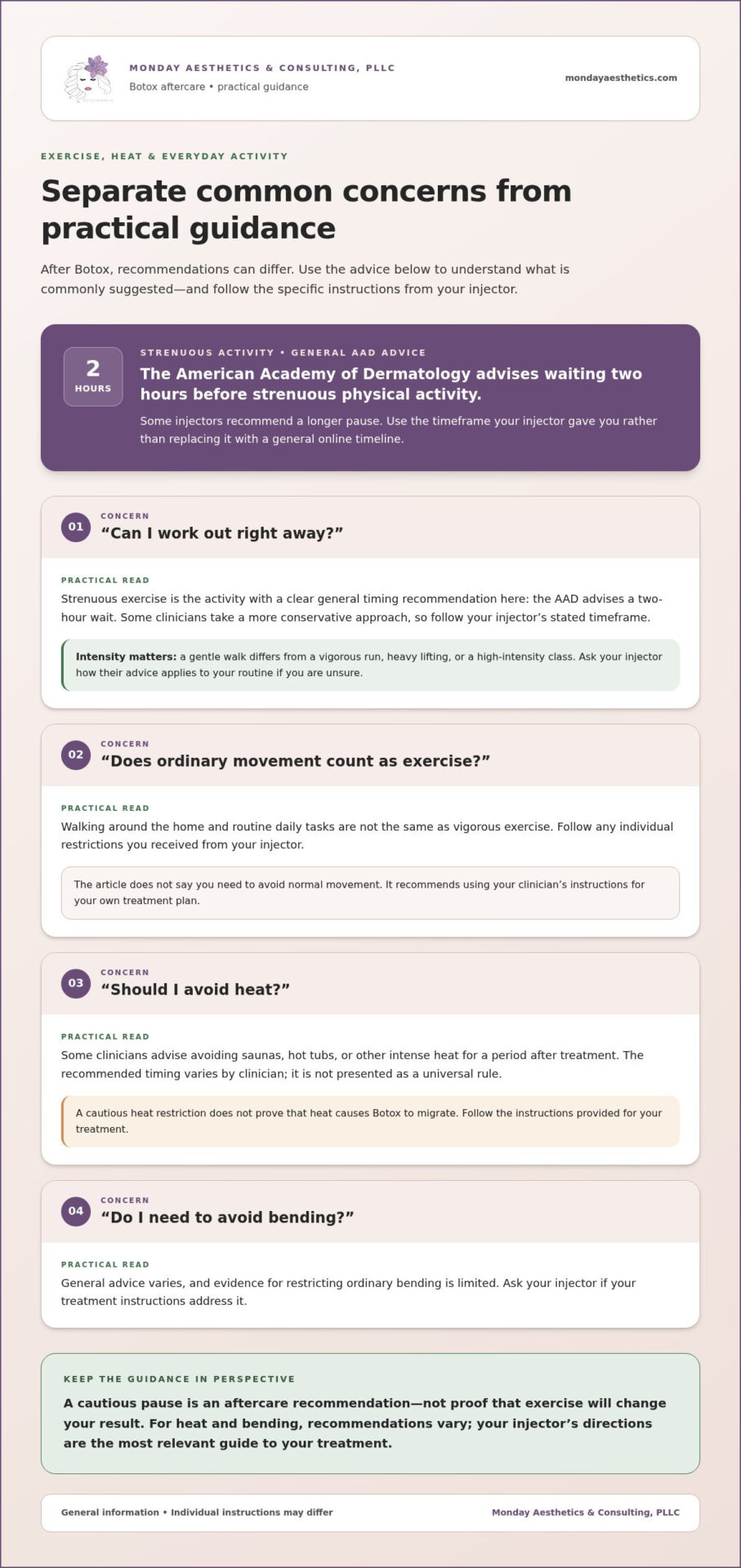
Advice about exercise and heat after Botox can sound more absolute than the evidence allows. Some clinicians recommend a cautious pause, but that doesn’t establish that ordinary movement or a workout will displace the treatment. The American Academy of Dermatology advises waiting two hours before strenuous physical activity. Other injectors may recommend a longer interval, so understanding what to avoid after Botox treatment means distinguishing general guidance from the specific plan you were given.
Use this comparison to interpret common advice without treating every precaution as a universal medical rule:
| Activity | How to think about it |
|---|---|
| Strenuous exercise | The AAD advises waiting two hours; some injectors suggest a longer pause. Follow your injector’s stated timeframe. |
| Light daily movement | Walking around the home or doing routine tasks isn’t the same as vigorous exercise. Follow any individual restrictions you received. |
| Heat exposure | Some clinicians advise avoiding saunas, hot tubs, or intense heat for a period after treatment. The timing is clinician-dependent, not a universal rule. |
| Bending | General advice varies, and evidence for restricting ordinary bending is limited. Ask your injector if your treatment instructions address it. |
Should you postpone strenuous exercise?
Exercise guidance differs between injectors and protocols. The AAD’s general advice is to wait two hours before strenuous activity, while some clinicians take a more conservative approach. Use the timeframe your injector gave you instead of substituting a timeline from an online checklist. A cautious pause may be part of that clinician’s aftercare approach; it shouldn’t be presented as proof that exercise will change your result.
If you’re unsure whether an activity counts as strenuous, consider its intensity. A gentle walk differs from a vigorous run, heavy lifting, or a high-intensity class. Your injector can clarify how their recommendation applies to your routine.
Do heat, bending, or normal movement require special restrictions?
Saunas, hot tubs, and other intense heat are sometimes included in conservative aftercare instructions. Clinicians may prefer to limit activities that raise body temperature or blood flow soon after injections, but that rationale doesn’t prove heat causes Botox to migrate. Recommendations vary, so follow the instructions provided for your treatment rather than assuming one timeline applies to everyone.
Ordinary bending to pick something up or moving through daily tasks isn’t equivalent to strenuous activity. There’s no need to keep your body still unless your clinician has given you a specific reason. For a broader overview of general recommendations, consult the American Academy of Dermatology’s Botox guidance.
Individualized instructions matter more than blanket timelines because your injector can account for your treatment plan and circumstances. If you have an unusual symptom, a medical concern, or conflicting directions, ask your treating clinician how to proceed. For patients in Burlington, Washington, a conversation about personalized Botox care can help put general aftercare guidance into context.
Botox Aftercare Myths: Sleeping, Facial Expressions, Makeup, and Alcohol
Online aftercare lists can make ordinary habits sound like rules with no room for context. A more useful approach is to separate what’s commonly recommended from what’s necessary for every patient. This table offers practical guidance on sleeping, facial expressions, makeup, and alcohol without treating any restriction as a guarantee of a particular result.
| Common claim | Practical guidance |
|---|---|
| “You must sleep on your back.” | Some injectors recommend avoiding pressure on treated areas, especially soon after injections. A required sleeping position isn’t a universal evidence-based rule; follow any specific instruction your clinician gave you. |
| “Don’t smile or frown after treatment.” | Normal facial expressions aren’t the same as rubbing or deliberately manipulating injection sites. You don’t need to keep your face still unless your injector has given you individualized advice. |
| “Makeup is always off-limits for a set period.” | Timing can depend on the injection sites and your injector’s protocol. Avoid pressing or dragging products over treated skin, and follow the directions you received. |
| “Alcohol will definitely cause bruising.” | Some clinicians advise limiting alcohol around treatment because bruising is a consideration, but it isn’t accurate to promise that avoiding alcohol will prevent bruising or that drinking will cause it. |
Does smiling, frowning, or sleeping in a certain position affect Botox?
It’s natural to wonder whether smiling, frowning, or turning onto your side in bed could interfere with treatment. Everyday facial expressions are part of normal movement, not deliberate massage of injection sites. Advice to sleep on your back may be a cautious preference intended to limit pressure, rather than a universal requirement for everyone. If your treating clinician gave you a specific sleeping instruction, follow it. Otherwise, don’t assume one position is essential.
If you wake up having changed positions, there’s no need to repeatedly inspect or press the treated areas. Simply return to the instructions you were given. Avoiding unnecessary pressure is a sensible precaution, but no single sleeping position can guarantee a result or prevent every side effect.
When can you wear makeup or drink alcohol?
Consider makeup advice in relation to the injection sites. Your clinician may recommend waiting before applying products, particularly if application would involve rubbing or pressing the skin. If your instructions allow makeup, use a light touch and avoid aggressive blending over treated areas. Don’t treat a generic online timeline as a substitute for your injector’s guidance.
Alcohol recommendations also vary. Some clinicians suggest avoiding it around treatment as a cautious way to address bruising concerns, but that isn’t proof that alcohol will cause bruising or that abstaining prevents it. Follow the advice provided for your treatment, especially if your medical history or medications raise questions. Sensible aftercare focuses on avoiding unnecessary pressure, not rigid rules about every expression, bedtime, or routine choice.
Botox Aftercare Checklist: What to Do & When to Seek Advice
A clear plan can make the hours after treatment feel simpler. Start with the instructions your injector provided, then use them to guide contact with treated areas and your return to regular activities. Minor effects at injection sites can occur, but symptoms that are significant, worsening, or unexpected deserve professional attention. This checklist helps distinguish routine aftercare questions from concerns that shouldn’t wait.
A practical first-day checklist
- Review your instructions. Read the written guidance from your injector and keep it somewhere easy to find. If verbal directions and written instructions seem to conflict, contact the treating clinician for clarification rather than guessing.
- Leave treated areas undisturbed. Avoid rubbing, massaging, or pressing on injection sites unless your clinician has specifically instructed you otherwise. Try not to repeatedly touch the area to check how it feels.
- Resume activities as directed. Use your injector’s individual guidance for exercise and other activities. If the instructions don’t address something you’re planning to do, ask the treating clinician how to proceed.
- Notice how you’re feeling. Keep track of changes without overchecking the treated areas. A brief note of when a symptom began and whether it’s improving or worsening can help you describe it clearly if you seek advice.
This is a practical framework, not a substitute for personalized care. Advice can vary with the treatment plan and your circumstances, so general online information about what to avoid after Botox treatment shouldn’t override the instructions given for your injections.
Which symptoms should prompt medical attention?
Some localized effects, such as mild tenderness, redness, swelling, or bruising around injection sites, may occur after injections. Monitor them and follow your injector’s directions. If an effect feels severe, worsens, persists in a way that concerns you, or seems unexpected, contact the clinician who treated you for an assessment. Don’t rely on an online search to diagnose the cause.
Seek urgent medical help for symptoms such as trouble breathing or swallowing, marked weakness, or vision changes. These are not routine aftercare questions.
- For a minor, stable concern: follow your aftercare instructions and contact your treating clinician if you need guidance.
- For a significant or worsening symptom: seek prompt professional assessment rather than waiting to see whether it resolves.
- For trouble breathing or swallowing, marked weakness, or vision changes: contact local emergency services immediately; don’t wait for a routine appointment.
Routine questions can go to your treating clinician; urgent symptoms need immediate medical attention. If you’re unsure which category your concern falls into, describe the symptom and when it started to a medical professional, and follow their direction.
For individualized Botox aftercare in Burlington, Washington, learn about Botox care at Monday Aesthetics. The practice is led by board-certified Nurse Practitioner Thea Anderson, and treatment-specific guidance can help you take your next steps with greater clarity.
Personalized Botox Aftercare in Burlington, WA: Your Next Step
General aftercare lists can offer a useful starting point, but they can’t account for the details of your treatment or health history. Your treating clinician can explain which precautions apply to the areas treated, how to follow your instructions, and what to do if a concern arises. That context matters more than trying to follow every rule you encounter online.
How individualized instructions support a considered treatment experience
A thoughtful conversation includes more than the treatment area. Sharing relevant health information, asking what to expect afterward, and discussing your usual activities can help your clinician tailor guidance to your circumstances. Your instructions may differ from another patient’s, and follow-up needs aren’t identical for everyone. Rather than assuming what to avoid after Botox treatment based on a generic checklist, use the guidance provided for your care.
Before treatment, consider noting the questions you’d like answered. You might ask how to handle your usual exercise routine, what to do if you notice an unexpected change, or how to reach the treating clinician with a non-urgent concern. Clear answers can make it easier to follow your plan without adding restrictions that weren’t recommended for you.
After treatment, keep the instructions accessible and follow them as written. If you’re unsure about a detail, seek clarification from the clinician who knows your treatment rather than relying on advice intended for someone else or a different procedure. Connecting treatment planning with aftercare supports a more informed experience while leaving room for your individual needs.
Considering Botox in Burlington?
Monday Aesthetics & Consulting provides Botox care in Burlington, Washington. The practice is owned and operated by Thea Anderson, a board-certified Nurse Practitioner. A conversation about your goals, health context, and aftercare questions can help you understand whether Botox may suit your preferences and what individualized guidance could involve. The aim is an informed decision, not a one-size-fits-all routine or a promised result.
If you’re considering Botox, you can explore Monday Aesthetics’ Botox service and consultation options. Bring the questions that matter to you, including how treatment planning and aftercare guidance are approached. If you’ve already been treated, concerns specific to your injections are best directed to your treating clinician, who can respond in light of your treatment details.
Choosing a local practice can make it easier to connect treatment questions with a clinician familiar with your care. Whether you’re gathering information or preparing for a consultation, take time to understand the plan and the instructions that accompany it. A measured approach lets you make choices with clarity and supports aftercare that feels practical, personal, and grounded in professional guidance.
Move Forward With Confidence in Your Botox Care
Let your next step be a conversation, not a search for one more universal aftercare rule. If you’re considering Botox, note what you hope to address and any questions about treatment, your health history, or how aftercare may fit your routine. A thoughtful discussion can help you understand the choices before you decide, without pressure to move faster than feels right.
Knowing what to avoid after Botox treatment is most useful when paired with guidance that reflects your own care. General information can orient you, while your treating clinician can speak to your treatment details and concerns. If you’d like to learn more about Botox at Monday Aesthetics, explore Botox care and consultation options.
Take the time you need, ask the questions that matter to you, and choose the next step with clarity. Your care should feel considered and personal.
Frequently Asked Questions
Can I exercise after Botox treatment?
Exercise guidance after Botox varies by injector and treatment protocol. Follow the specific timeframe you were given rather than assuming a universal restriction or that a workout will necessarily change your result. Strenuous training, such as a hard run or heavy lifting, differs from ordinary movement like walking around your home. If your instructions were unclear, contact the treating clinician before returning to intense exercise.
How long should I avoid rubbing my face after Botox?
Injectors commonly advise avoiding unnecessary pressure or massage near injection sites for the period they specify. There isn’t one timeframe that applies to everyone, so check your written instructions if you’re planning a facial, using a massage tool, or applying a product that requires firm rubbing. A brief accidental touch doesn’t automatically mean treatment was affected. If you’re concerned, ask the clinician who performed your injections.
Can I wear makeup after Botox injections?
Makeup timing can depend on the injection sites, your skin’s condition, and your injector’s aftercare protocol. Apply it gently only when your clinician’s instructions allow, taking care not to press or massage treated areas while blending or removing products. If you have a work event or plan to apply makeup soon after treatment, ask the practice for guidance rather than relying on a universal waiting period.
Is it safe to lie down or sleep normally after Botox?
Advice about lying down and sleeping position varies, so don’t treat a particular position as a universal rule. Follow any specific sleeping instructions from your treating injector, and avoid deliberately pressing or massaging injection sites. If you weren’t given special sleeping guidance, contact the practice that performed your injections for advice tailored to your treatment. Waking up in a different position isn’t, by itself, a reason to panic.
Can I drink alcohol after Botox treatment?
Some clinicians recommend caution around alcohol because bruising considerations can vary, but alcohol doesn’t always cause complications or change treatment results. Follow the instructions your injector provided, particularly if you tend to bruise easily or take medication that may affect bleeding. Don’t stop or change prescribed medication on your own. If you have questions about how your medication and alcohol relate to treatment, ask your clinician.
When do Botox results appear, and should I avoid a touch-up right away?
Botox results develop gradually, and timing varies from person to person. The timeframes cited in this guide say changes often begin within 3 to 5 days and settle over 10 to 14 days, but those timeframes aren’t a promise for an individual. Follow your injector’s recommended review schedule before considering more treatment. Raise concerns about asymmetry or unexpected changes directly with the treating clinician.
What should I do if I forgot my Botox aftercare instructions?
You don’t need to piece together conflicting online lists. Contact the practice that performed your injections and ask for its written directions, especially before strenuous activity or a facial treatment. Don’t double up on restrictions or try to adjust the treatment yourself. If you’re in Burlington, Sedro-Woolley, Mount Vernon, Stanwood, Arlington, Marysville, Bellingham, Lynden, Everett, Anacortes, Oak Harbor, or La Conner, contact your treating practice directly. Seek urgent care for severe or rapidly worsening symptoms.